




How to Import Freeze-Dried Okra: A Global Buyer’s Guide
Importing freeze dried okra successfully requires more than placing a purchase order. Procurement managers and formulators sourcing this ingredient for food manufacturing, functional nutrition, or ready-to-eat applications must navigate certifications, customs documentation, logistics planning, and supplier verification before a single shipment moves. This guide walks through every critical stage — from understanding the product's market value to managing landed costs and storage protocols — so your supply chain operates with confidence and consistency from day one.
Key Considerations When Importing Freeze-Dried Okra
Certifications That Protect Market Access
If a business wants to sell to people in the US, EU, or the Middle East, they have to follow the rules. Make sure the supplier of freeze dried okra satisfies the following certification standards before entering into a buy deal with them:
- FDA Facility Registration and HACCP Documentation: Required for all food ingredients entering the US market. HACCP plans must be product-specific and audit-ready.
- HALAL and KOSHER Certifications: Essential for buyers serving Middle Eastern retail channels or observant consumer demographics in North America.
- USDA Organic Certification: Differentiates products for premium health food brands and retailers requiring third-party organic verification.
- FSSC 22000 or ISO 22000: Internationally recognized food safety management systems that signal process-level control beyond basic product testing.
- BRC Global Standard: Preferred by European retailers and distributors as a baseline quality benchmark.
These licenses do more than just what the law says they have to do. They show that production is constant and can be shown in writing by procurement managers during reviews of internal sourcing and checks on when suppliers are hired.
Packaging and Customs Requirements
Freeze-dried vegetable products can't get much water in them. If the humidity level goes above 30–40% for a short time, the moisture content can rise above the important 5% level and damage the product's quality. Good suppliers put finished goods in high-barrier aluminum foil bags that are flushed with nitrogen to keep the water activity below 0.2 while the goods are being shipped.
To bring food products from China into the US, they need to give the FDA a Prior Notice, have the right HS code (usually 0712.90 for dried vegetables), and have a business invoice that fits the packing list exactly. Most of the time, CBP holds, and inspection delays are caused by papers that are not the same.
Selecting Reliable Freeze-Dried Okra Suppliers and Brands
Evaluation Criteria That Separate Credible Manufacturers from Brokers
Your choice of freeze dried okra source has a direct effect on the quality of your product, the dependability of your lead times, and your exposure to audits. The sellers you can trust don't hire other companies to do the lyophilization for them; they do it themselves. Also, they make sure that the farms where their raw materials come from are contracted and that their multi-standard certifications have been renewed by a third party that is not part of the company.
These are the main things that buying teams look at when they are deciding which suppliers to work with:
- Production Capacity and Lead Time: A credible manufacturer should demonstrate annual output capacity sufficient for your volume requirements. Avans NutriHealth operates facilities capable of producing over 1,000 metric tons annually, with in-stock availability for Freeze Dried Okra Dices in both whole and diced forms.
- Certification Portfolio: Avans holds HALAL, ISO, USDA, HACCP, and FSSC 22000 certifications, alongside BRC and Kosher accreditation — a multi-market compliance profile that reduces buyer-side due diligence burden.
- Sample Availability and COA Transparency: Request a Certificate of Analysis that includes moisture content, water activity, pesticide residue screening, and heavy metal panels before committing to a bulk order.
After reading the supplier's paperwork, either set up a facility check or ask a third party to give you a report. The cleanliness of the production area, the cold chain staging areas, and the packing lines can be seen in person, which is something that can't be seen from paper records alone. With these steps, you can build a connection with the supplier that is built on facts rather than trust.
Logistics and Cost Management for Importing Freeze-Dried Okra
There are many costs involved, and the price per kilogram is just one of them. It costs about USD 1,500 to USD 3,000 per 20-foot container to ship goods from Chinese ports to places on the US East Coast via ocean freight. Other costs that need to be considered are import taxes under HS 0712.90, FDA prior notice fees, customs brokers, and road drayage.
It takes 5–7 days to send goods by air freight instead of 25–35 days by sea, but each kilogram costs 6–8 times more. Large amounts of freeze-dried okra can be sent by sea freight for the lowest cost. This is because it doesn't need to be kept in a cold chain and can be kept at room temperature. Still, air freight is a good way to send samples, quick refills, or small amounts for test production.
If you have cargo insurance that covers the stated value of the package, it won't get lost or damaged by water while it's in transit. It is important to make it clear that the integrity of the packaging will be checked at the main warehouse before the containers are sealed. It is also normal practice to ask for picture proof.
Optimal Usage, Storage, and Handling Tips for Buyers
Preserving Product Integrity After Arrival
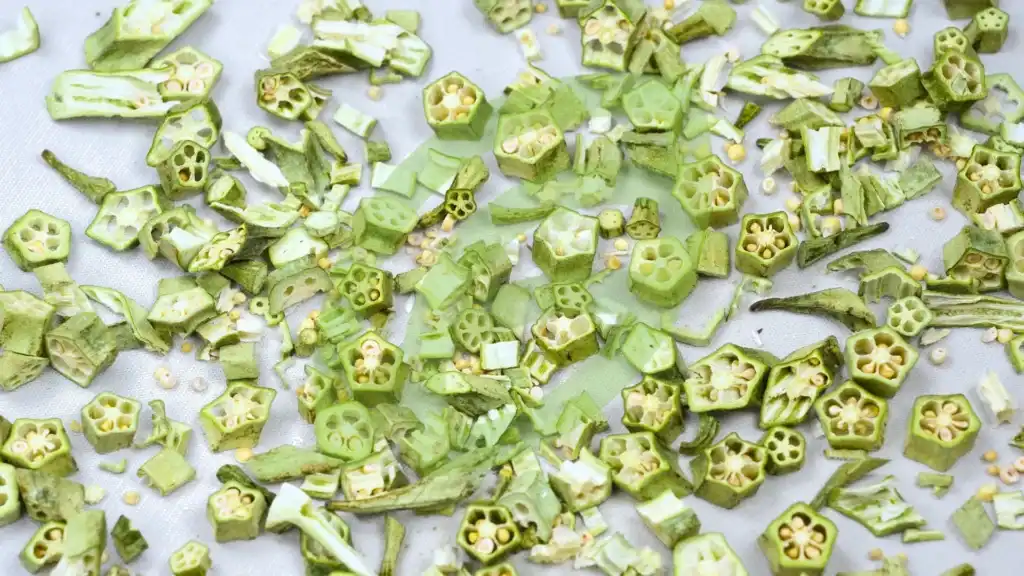
As soon as you get freeze-dried okra, put it in containers that are sealed and can't be seen through. Keep them away from light and heat sources that are directly on them. In a building, the temperature should stay below 25°C, and the relative humidity should stay below 40%. In these conditions, the food will stay fresh for 18 to 24 months without going bad.
About 100 grams of dried product turns into 1 kilogram of rehydrated ingredient. This ingredient can be used in soups, stews, ready-to-eat meals, or to mix with other things. If you are making food powder for drink mixes, healthy recipes, or baked goods, make sure you do it in a dry place and seal the container right away so the powder doesn't soak up any water.
If you want to make sure the quality is good, you should check samples from each new batch for moisture content (it should be less than 5%), chlorophyll preservation by looking at the color, and fracturability by feeling the structure. Lots that are soft, dirty, or smelly should be put in a different area until the seller makes a claim.
Conclusion
When importing a lot of lyophilized freeze dried okra, it's important to be organized about finding qualified sources, following the rules, figuring out how much the logistics will cost, and what to do with the food once it gets there. Teams in charge of buying things see these steps as a whole, rather than as separate tasks that need to be done in a certain order. This helps them avoid delays, keep product quality high, and build relationships with suppliers that ensure a steady supply. You can use this ingredient in many different ways, and it is good for you. It is also good for food manufacturers because it lasts a long time. At every step, though, it's important to be careful about where you get this item.
FAQ
1. Can freeze-dried okra be consumed without rehydration?
Yes. Some snacks are crisp, stay fresh for a long time, and can be eaten right away after being lyophilized. It doesn't need to be made ahead of time, and stores often season it so that it can be used as a snack.
2. How does freeze-dried okra differ from air-dried or dehydrated okra?
To process dried okra, heat is used. This breaks down vitamins that are sensitive to heat and changes the structure of cells in a big way. Products that are freeze-dried keep about 97% of their original nutritional value. They also keep their natural color because chlorophyll is stable, and they recover better than products that are dried at high temperatures.
3. What is the standard shelf life under commercial storage conditions?
To keep the food fresh for 18 to 24 months, put it in metal foil bags that have been flushed with nitrogen and store them somewhere cool and dry (below 25°C). There's no need to keep it cold.
4. What moisture specification should buyers require from suppliers?
Check the certificate to see if it says the moisture level is less than 5% and the water activity level is less than 0.2. Microbes can't grow past these limits, and the structure stays the same all the way through the transportation chain.
Partner with Avans for Premium Freeze-Dried Okra Supply
Avans NutriHealth Co., Ltd. is a well-known freeze dried okra producer with a yearly production capacity of more than 1,000 metric tons. They have been in business since 2005. Okra dices that have been freeze-dried are approved by HALAL, ISO, USDA, HACCP, and FSSC 22000. You can buy a lot of them, or have them with your own name on them. They are in stock. You can get examples, prices, and all the paperwork you need by emailing Lillian@avansnutri.com.
References
1. Grand View Research. Freeze-Dried Food Market Size, Share & Trends Analysis Report. 2023.
2. Fellows, P.J. Food Processing Technology: Principles and Practice (4th ed.). Woodhead Publishing, 2017.
3. U.S. Food and Drug Administration. Prior Notice of Imported Food. FDA Guidance Document, 2022.
4. Ratti, C. "Hot air and freeze-drying of high-value foods: A review." Journal of Food Engineering, 2001, 49(4), 311–319.
5. Sablani, S.S. "Drying of fruits and vegetables: Retention of nutritional/functional quality." Drying Technology, 2006, 24(2), 123–135.
6. U.S. Customs and Border Protection. Harmonized Tariff Schedule of the United States: Chapter 07 — Edible Vegetables. CBP, 2023.