




How Is spermidine trihydrochloride powder Tested for Purity?
Spermidine trihydrochloride powder is tested for purity with a layered set of checks, not a single number. Labs first confirm identity with HPLC retention data, LC-MS, or NMR. They then measure assay and related substances by HPLC or UPLC and confirm the salt form with chloride analysis. Karl Fischer titration measures water, gas chromatography screens residual solvents, and ICP-MS checks trace metals. A batch-specific certificate of analysis (COA) records every result. Our spermidine trihydrochloride powder (CAS 334-50-9) carries a specification of ≥98% by HPLC, and we confirm its structure by H-NMR. This guide shows U.S. buyers how each test works.
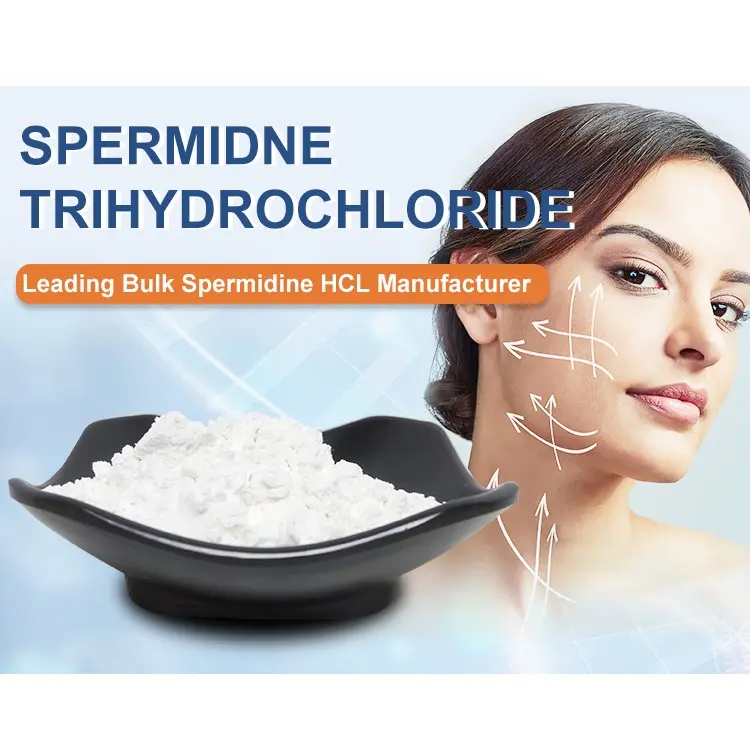
What Is Spermidine Trihydrochloride Powder, and Why Does Purity Need Context?
What Is Spermidine Trihydrochloride Powder?
The hydrochloride salt of spermidine is spermidine trihydrochloride powder. Spermidine is a physiological polyamine. Item number 334-50-9 on the CAS list, and its formula is C₇H₁₉N₃·3HCl (C₇H₂₂Cl₃N₃). A molecular weight of 254.63 g/mol is what it is. The powder we sell is from China and is white to off-white. It's easy to dissolve in water. Formulators should use the salt instead of the free base because the free base is sticky, unstable, and oxidizes quickly. The salt, on the other hand, stores and weighs like a normal powder. People buy it to learn more about nootropics, autophagy, nutraceuticals, and makeup. It should say something different on the label because it's not the same as wheat germ extract or finished supplements.
What Does "Purity" Mean in Procurement?
It's not always clear what "98%" means. The test tells you how much spermidine is in the sample by using a certain method and set of calculations. HPLC purity tells you how much of the peaks that were found are spermidine. The answer to this question is not one but two. There is no proof that it is salt or that it is not water, a liquid, or a metal. Make sure you know if a product is "as is" or "dry." Our spermidine trihydrochloride powder is at least 98% pure, as proven by HPLC. To learn how that number was found and what it doesn't show, you should read the whole COA.
Why Purity Testing Matters to B2B Buyers?
Mistakes in the raw materials get passed down the line. If the salt is in the wrong form, it changes how much is in each pill. Let's say you divide 254.63 by 145.25 to get 1.75 mg of the salt, which is the same as 1 mg of pure free spermidine. That number changes again when water is hidden. There may be solvents or metals that are still present after an import check, or a customer audit will fail. And when a new lot acts differently than the last one, it can cost R&D teams weeks of work and cause shipments to be turned down. It costs more for things to go wrong than for the test to find them. Because of purity testing, the teams that buy, check for quality, and make the product can all see the same record. So, they can agree on a lot of things based on facts instead of just trust.
How Is Spermidine Trihydrochloride Powder Tested for Identity and Assay?
Identity and assay come first, so let us start with the core analytical methods.
HPLC and UPLC for Assay and Related Substances
First, we need to be sure that the sample is what it says it is and that it is pure. Let's start with the most common ways to analyze samples. HPLC is the best way to do both of these things. For each peak, it separates spermidine from other polyamines that are like it, such as putrescine and spermine. UPLC works the same way, but the particles are smaller, and the runs happen faster. So, labs often derivatize spermidine with chemicals like dansyl or benzoyl chloride or use detectors like mass spectrometry, charged spray, or evaporative light scattering. This is because spermidine is very polar and doesn't absorb much UV light. System fit checks are discussed in Chapter 621 of the USP manual. These checks make sure that the instrument separates and measures correctly before samples are run. It is up to you to ask your supplier if the method has been checked for ICH Q2(R2) specificity, accuracy, precision, and linearity.
LC-MS and NMR for Structure Confirmation
An HPLC retention time doesn't show that there is structure. LC-MS tells us about mass: 145.25 Da is the mass of free spermidine, and m/z 146 is the mass of a protonated ion. LC-MS can also help you find a peak you don't know about. This is where proton NMR (H-NMR) comes in. It creates a picture of the hydrogen atoms along the carbon chain and can find extra building blocks or cellular waste that a UV monitor might miss. An HPLC test tells us how pure our spermidine trihydrochloride powder is, and an NMR test tells us how its chemicals are put together. This helps us figure out what synthesis leads to. Look for a note that says "spectrum matches reference structure" on the COA.
Chloride, Salt Form, and Water Content
Each molecule of the trihydrochloride salt should have three chloride ions. By weight, this means it has about 41.8% chloride (106.36 ÷ 254.63). Ion chromatography or silver nitrate titration can be used to test chloride. The result should match the theoretical number. It means that either the salt form is wrong or there is too much water if the number is not 41.8%. The elements carbon, hydrogen, and nitrogen are looked at again for a second time. It doesn't matter how much water there is. Since it measures moisture directly, Karl Fischer titration is a more accurate way to find out how much something has dried out. You can pick up water from the air, so this number changes both the test and the real weight you get.
Which Additional Tests Belong in a Complete Purity Evaluation?
Identity and assay are only the start. These extra tests cover the remaining risks.
Residual Solvents by Gas Chromatography
Sometimes, organic solvents like ethanol and methanol are used to make things and to form crystals. Headspace gas chromatography is used to find what's still in the powder. Based on how dangerous they are, ICH Q3C divides solvents into three groups: Class 1 is the worst and should be avoided, Class 2 has limits, and Class 3 is not as dangerous and is more likely to be safe. There needs to be a different GC method for these solvents because this HPLC-UV method can't always detect them. On the COA, you can write down boundaries and ask for the GC findings. Find out a list of the chemicals that were used and how much of each one was used. Plus, if the final product is a vitamin, this helps your quality team keep track of which suppliers have been checked out.
Elemental Impurities by ICP-MS
Reagents, catalysts, or tools can be used to turn metals into a powder. You can find very small trace elements with both ICP-MS and ICP-OES. It is because these four are dangerous that they are in Class 1 of ICH Q3D. This is why most buyers ask about them first. When people in the US buy food, cosmetics, or nutraceuticals, they often set their own limits. Stores may also make the limits stricter. Try to find a simple report that fits the goods you want to sell and the people you want to sell them to. As well as the name of the test method and detection limits that are well below what is needed, make sure that the report has units like ppm or µg/g.
Microbiology and Physical Checks
Pathogens like Salmonella and E. coli are usually what microbiology tests look for, alongside yeast and mold. Food, drinks, feed, and mouth supplements are the things that need it the most. A few simple checks done in person finish the picture. It should look like a powder that is white to light white. A cloudy or yellow solution could mean that something won't dissolve or that the powder is breaking down. This is because powder is easy to dissolve in water. For the solubility test, you need to name the solvent and the concentration. These checks are cheap and quickly show when batches are different. Before you make your first order, talk to your supplier about what the pass factors are. That way, the same rules will be used to judge each lot.
How to Read a COA, Compare Suppliers, and Spot Misleading Results?
Lab data only helps when you can read it and trust its source.
How to Evaluate a COA?
A COA is only useful if it is easy to understand. Seek out the item's name, its CAS number 334-50-9, the lot number, the date it was made, the limits of its specifications, the real results, and the ways it was tested. Check the information about the retest or expiration date as well, if there is one. Check to see if the test is "as is" or "dry," and make sure the release was signed by someone from quality. There shouldn't be just "purity: 98%" on a certificate. No matter how dangerous the job is, you should ask for chromatograms, NMR spectra, an SDS, and studies on elements or microbes. Every batch of spermidine trihydrochloride powder we send out comes with a COA. We can also help your reviewers read every line.
How to Compare Spermidine Trihydrochloride Suppliers?
Prices and news stories don't always tell the whole story. Read about the limits of the assay, standards for related substances, frequency of testing, method validation, and the ability to keep track of a lot. Then look at how far the certificate can reach. There is information from COA, ISO, USDA, HACCP, FSSC22000, and HALAL for our spermidine trihydrochloride entry. Also, Avans NutriHealth is a kosher, BRC, and organic business. Think about how ready you are to export by going over the number of items you need, the lead time, the packaging, and the Incoterms. We have our items in stock, and every year our plant can make up to 1,000 tons of different goods. There are also 338 partners who sell our goods in over 280 cities. For private name and unique package jobs, we also do OEM and ODM work.
What Causes Misleading Purity Results?
A lot of things can change what happens. You might not be able to separate spermidine from spermine or putrescine if you do it the wrong way. Sometimes salts make it tough to find things. The reported amount of the free base and salt will be about 75% different if you do the math. The test is changed by the amount of moisture that is taken in, and one bottle may not show much. Do not use small test pieces when taking samples. Instead, use samples from more than one container if you can. For projects with a higher risk, it's best to use qualified reference standards, keep track of how samples were handled, use samples that were kept, and consider getting independent testing done before shipping. Make sure your source writes down how they measure so that your lab and theirs can compare the same amount.
Storage, Procurement, and Quality Control After the Lab Test
There still needs to be a clear way to buy things and good records for test results.
How to Store the Powder to Preserve Quality?
Always stick to what the supplier says and read the SDS first. Store the powder in a container with a tight lid and away from light in a cool, dry place. Store things for a long time at 2–8°C. Moisture-barrier inner bags, sealed outer containers, and clear lot labels keep the items safe while they are being stored and shipped around the world. How stable is the package you chose? Find out if the shelf life or repeat time given is based on facts. Also, write down how to handle an open container. If you leave it in damp air for a long time, it may clump together and gain water. If you keep your COA properly, the assay on it will stay close to the assay in your mixture.
A Practical Procurement Checklist
Follow these three steps to make sure that most of the things you buy are safe before you trust a source.
- Define the specification. Write down the grade, the target assay and calculation basis, the impurity limits, the package size, the annual volume, and the market where the product will be sold. Some businesses, like those that make vitamins and makeup, may need to set different limits. There is a clear "pass" or "fail" standard for your quality team when there is a written guideline. This makes sure that all of the quotes from sources are the same.
- Request the documents. Ask for the most up-to-date specification, a COA for each batch, the SDS, a method summary, proof of certification, details on how to package the goods, and documents for export. You can add chromatograms, NMR spectra, or chemical reports when your job gets more dangerous. It is less expensive to look over these files before the first sale than to fix a problem with a review that comes in after the fact.
- Confirm the commercial terms. Before you place an order, make sure you have a written confirmation of the MOQ, sample policy, lead time, pricing structure, Incoterms, and shipping conditions. Make sure you can get OEM and ODM help right away if you want to use a private name or custom packaging. You can then make sure that the artwork, pack sizes, and testing requirements are all in line with when you want to launch the product and how you usually do it.
Together, these steps turn a vague quote into a written decision. This makes it less likely that shipments will be turned down.
Why Documented Quality Control Supports B2B Decisions?
Every team has the same way to get approval when there is a written quality method. When buyers and sellers compare, they do it fairly, and they back up what customers check. The research and development teams test more, which means they don't have to worry as much about wetness, impurities, or using the wrong kind of salt. Official Manufacturers (OEMs) and Private Label Manufacturers make it clearer how batch releases work and make sure that the needs of the raw materials and the needs of the finished product are met. Keeping consistent records can also help you look over imports and keep track of long-term suppliers. It may be cheaper in the long run to buy something that was quoted at a higher price if it doesn't need to be reworked or rejected. For Avans NutriHealth, for ISO 22000, HACCP, and BRC quality methods to work, they all need records that can be found. Record keeping is also faster when things are clear.
Conclusion: A Purity Percentage Is Only the Starting Point
To find out if spermidine trihydrochloride powder is pure, you can use more than one method, not just one percentage. LC-MS and NMR confirm the substance's name and structure, while HPLC or UPLC measure the assay and substances that are linked to it. Chloride analysis and Karl Fischer titration are ways to find out what kind of salt is present and how much water is there. ICP-MS and gas chromatography are two ways to find any metals or liquids that might still be there. Microbiology, appearance, and stability checks can help keep you safe. When you mix the free base and the salt, the content changes by about 75%. Assay and HPLC purity give you different results. So, a COA for a specific batch should list the methods, limits, results, and the basis for the calculations. Careful sampling, long-term storage at 2–8°C, and a written specification allow suppliers to share results that are similar. Documented, multi-method proof helps make formulations more uniform and acceptance decisions clearer. It does this instead of a single number.
FAQ
Does HPLC purity equal assay?
No. The HPLC concentration tells us how much of the peaks we found are caused by spermidine. An assay compares the real substance to a standard to figure out what it is. Ask for both the numbers and the steps that were used to get them. Without the other, one can lead you astray.
Which tests should a COA include?
The core set is made up of identification, assay, related chemicals, and moisture. Add residual solvents, elemental impurities, and microbiology based on the use, risk level, and market you're going to.
How do you verify the absence of synthetic contaminants?
We use HPLC to make sure the chemical is pure and H-NMR to look at its structure. These tests help us find by-products and precursors of synthesis that haven't been broken down yet in the powder.
How should the powder be stored?
It should be kept in a cool, dry place with a lid that fits tightly to keep light out. For a long time, keep the powder between 2 and 8°C, and make sure it stays in a package that keeps water out until you need it.
Is the powder soluble in organic solvents?
It's easy for water and physiological salt to break it down. Water is the best liquid to use for studies, treatments, and a lot of other things. Since it doesn't mix well with ether and ethanol, you need to be careful when planning your fluid system during preparation.
Request Spermidine Trihydrochloride Powder Documentation from Avans NutriHealth
It is always in stock at Avans NutriHealth to buy spermidine trihydrochloride powder. You can use it for OEM and ODM projects, and HPLC says it is at least 98% pure. It comes with a lot of COAs. Here are some of the certificates: HALAL, ISO, HACCP, and FSSC22000. Want to buy spermidine trihydrochloride powder and get test results for it? Please email Lillian@avansnutri.com with your application, grade, volume, and target market. We'll check into it and get back to you with a price. Visit https://www.avansnutri.com/ to learn more.
References
1. Science, 2018. "Spermidine in Health and Disease," Madeo F. et al.
2. Nature Cell Biology, 2009. "Induction of Autophagy by Spermidine Promotes Longevity," Eisenberg T. et al.
3. ICH Q2(R2) Validation of Analytical Procedures, 2023.
4. ICH Q3C(R8) Guideline for Residual Solvents, 2021.
5. ICH Q3D(R2) Guideline for Elemental Impurities, 2022.
6. United States Pharmacopeia, General Chapter <621> Chromatography, 2022.