




Ginseng Root Extract Powder OEM Guide for Custom Formulas
If you are a procurement manager, formulator, or R&D professional sourcing botanical actives for nutraceutical, pharmaceutical, or cosmetic manufacturing, ginseng root extract powder should be on your shortlist. This concentrated adaptogenic ingredient is derived from the dried roots of Panax ginseng C.A. Meyer and standardized for ginsenoside content via HPLC. It simultaneously resolves three persistent supply-chain challenges: batch-to-batch inconsistency, heavy-metal accumulation from long-cycle cultivation, and poor solubility in functional formulations. This tutorial takes you through all you need to know to analyze, procure, and formulate using this high-demand botanical at scale.
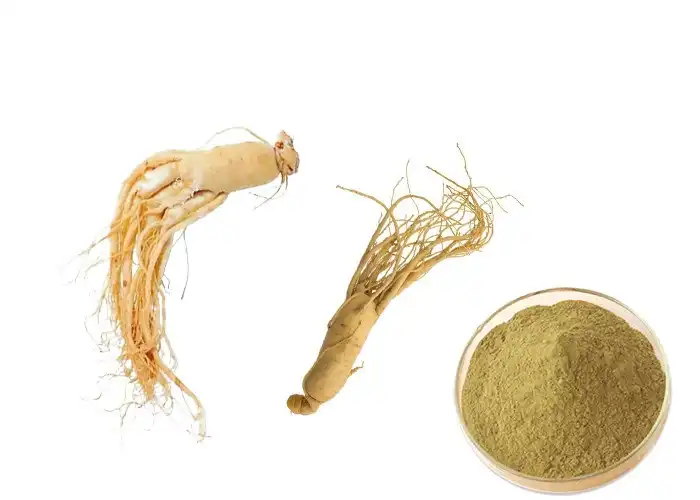
Understanding Ginseng Root Extract Powder: Key Facts for OEM Clients
Raw ginseng root powder is just powdered root fiber. It provides 1–3% ginsenosides and the full load of contaminants from six years in soil cultivation. By comparison, a water-ethanol extracted and spray-dried ginseng root extract powder provides standardized ginsenoside concentrations, usually 10 percent, 20 percent, 40 percent, or even 80 percent by HPLC, in a low-volume, dispersible powder that easily integrates into finished-dose production.
Active Compounds That Drive Efficacy
The pharmacological importance of this extract is attributed to its ginsenoside monomer profile. Important components were Rb1, Rg1, and Re, with different physiological activities. Rg1 is a central nervous system stimulant and improves short-term cognition. Rb1 has sedative and anxiolytic effects. The Rg1:Rb1 ratio is therefore a quality metric of clinical relevance, not a cosmetic standard. Standardized ginsenoside consumption improved fatigue resistance, immunological regulation, and working memory in healthy people (Journal of Ginseng Research, 2018).
Dosage, Safety, and Regulatory Positioning
The usual clinical doses for adaptogenic use are 200 mg to 400 mg of standardized extract per day. Formulators should be aware that ginsenosides do interact with CYP450 enzymes, and so there are contraindication issues with anticoagulants. In the U.S., ginseng root extract powder is controlled as a dietary element under DSHEA, while in the EU, it is regulated under botanical food supplement rules. Before entering the market, you need to check that your selected extract has HPLC-verified assay certifications and batch-specific heavy-metal reports.
Evaluating OEM Panax Ginseng Extract Options: What Procurement Managers Should Know
The three main physical forms in the OEM market are bulk ginseng root extract powder, liquid extract concentrate, and pre-encapsulated material. The powder format offers the highest price-per-kilogram efficiency and the most flexibility in formulation; hence, it is the ideal format for contract manufacturers who produce capsules, tablets, drinks, and topical serums from one raw material inventory.
Organic vs. Conventional: Certification Impact on Cost and Market Access
The USDA Organic and EU Organic certified ginseng root extract powder is priced at a 25-40% premium to conventional grades, but it opens the door to shelf placement with natural and premium-positioned merchants in North America and Europe. For the nutraceutical contract manufacturing market where cost efficiency and verified purity — not organic status — are the key drivers for purchase, non-organic pharmaceutical-grade material under ISO, HACCP, FSSC22000, and HALAL certification continues to be the preferred option.
Supplier Evaluation Criteria
Selecting the right manufacturer requires scrutiny beyond a certificate of analysis. Here are the criteria that consistently separate reliable long-term partners from transactional vendors:
- Standardization method: Insist on HPLC quantification rather than UV spectrophotometry alone. HPLC distinguishes individual ginsenoside fractions, while UV measures total saponin absorbance non-selectively.
- Particle size and bulk density: Pharmaceutical-grade material should pass 95% through an 80-mesh sieve, with bulk density between 0.45–0.65 g/ml—parameters that directly govern encapsulation machine throughput.
- Traceability documentation: Farm-of-origin records, cultivation-year data, and batch-specific pesticide residue reports are indispensable for FDA and EU customs clearance.
- Thermal stability data: Verify that the extract maintains ginsenoside integrity at temperatures up to 60°C to support tablet compression and pasteurization processes without degradation.
These evaluation points translate directly into reduced reformulation risk and fewer regulatory hold-ups at the port of entry.
Custom Formulation Strategies Using Ginsenoside-Standardized Extract
Mapping a high-assay ginseng root extract powder across product categories reveals its adaptability. The extract shows a synergistic action with ashwagandha (Withania somnifera) standardized for withanolides in adaptogenic supplement blends. The two herbs work on HPA-axis control and provide complementary fatigue-resistance benefits at lower individual dosing.
OEM Development Workflow
The structured OEM development process is broken down into the following four distinct phases: formula idea and target-claim definition; raw material specification lock; small batch prototype manufacturing; and stability and dissolution testing, prior to scale-up. Locking ginsenoside assay requirements at the specification stage minimizes expensive substitutes mid-development as lead times narrow.
Application-Specific Formulation Notes
The extract’s moderate to high cold-water solubility and stability in acid systems might benefit functional beverage producers. Maltodextrin carrier technologies allow high-speed encapsulation lines to run more smoothly at lower assay grades (10–20%) without sacrificing active content. In the area of cosmeceutical use, such as anti-aging serums and collagen-boosting creams, the extract showed good compatibility with standard emulsifiers and synthetic preservatives, with no oxidative color change when added in emulsion matrices at 0.5-2.0% w/w.
Navigating Bulk Procurement and Supply Chain
The price per kilogram of standardized ginseng root extract powder varies considerably according to the assay level, certification stack, and the yearly purchasing volume. The 10% ginsenoside powder is far cheaper than the 40% HPLC grade product, and then you have the expense of the USDA Organic certification on top of that. One of the lowest-hanging fruit cost optimization choices procurement teams may make is aligning specifications to real formulation requirements as opposed to defaulting to the highest assay available.
Ginseng root extract powders via commodity channels are counterfeit and contaminated. Mitigation begins with supplier audits, either on-site plant inspections or third-party audit reports, and independent lab verification of incoming raw material against the supplier's CoA. For certified producers, minimum order quantities are typically 25 kg for specialty grades and above. Dual-sourcing contracts with a pre-qualified secondary supplier protect production schedules from seasonal raw material supply disruptions due to climatic fluctuations affecting harvests in Northeast China, the main production region.
Future Trends and Innovations in Ginseng OEM Manufacturing
Green extraction methods, such as supercritical CO₂ and enzymatic-assisted extraction, are gaining popularity, since they decrease the danger of solvent residue and environmental impact of concentration operations. Nano-encapsulation of ginsenoside fractions is a hot field of commercial R&D, and preliminary evidence indicates increases in absorption of 30-50% compared to traditional spray-dried powder (Food & Function, 2021).
With the increasing demand for sustainably sourced and traceable botanicals among B2B customers in the U.S. and Europe, supply-chain transparency documentation is becoming a competitive differentiator, not just a compliance afterthought. Through strategic OEM collaborations based on co-development agreements, brand owners may obtain access to patented extraction technologies and have early access to new delivery formats before they become available in commodities markets.
Conclusion
Obtaining a ginsenoside-standardized ginseng root extract powder for OEM manufacture is a multi-layered choice that ranges from analytical chemistry to regulatory compliance to supply-chain risk management. The parameters that really matter – HPLC-confirmed assay, particle size, bulk density, thermal stability, and complete traceability – are not nice-to-have conveniences. These are the factors that decide whether your final product operates consistently at scale. By working with a vertically integrated, certified manufacturer, the gap from raw material specification to market-ready product is reduced.
FAQ
1. What ginsenoside assay level is most suitable for dietary supplement capsules?
For standard adaptogenic supplement applications, a 20–40% ginsenoside assay measured by HPLC offers the best balance between dosage efficiency and cost. Higher assay grades (60–80%) are typically reserved for pharmaceutical preparations or premium nootropic formulas where a low fill-weight per capsule is critical.
2. How do I confirm that a supplier's ginseng extract is genuinely HPLC-standardized?
Request a batch-specific HPLC chromatogram alongside the CoA. A genuine HPLC report will identify individual ginsenoside peaks (Rb1, Rg1, Re) with retention times, not simply a total saponin number from UV absorbance.
3. What is the shelf life of bulk ginseng root extract powder?
Properly sealed, stored below 25°C, and away from direct light, pharmaceutical-grade extract maintains ginsenoside potency for 24 months. Moisture content controlled below 5% is the single most important stability parameter for long-term storage.
4. Can ginseng extract be used in both water-based and oil-based cosmetic formulas?
The extract is primarily water-soluble and performs best in aqueous-phase cosmetic matrices such as serums, toners, and emulsions. Direct incorporation into anhydrous oil phases requires a pre-solubilization step with a hydrophilic co-solvent.
Partner with Avans for Premium Ginseng Root Extract Powder Supply
Avans NutriHealth Co., Ltd. manufactures pharmaceutical-grade ginseng root extract powder with standardized ginsenosides from 10% to 80% HPLC, certified under ISO, USDA, HACCP, FSSC22000, and HALAL—ready to ship from our Qingdao facility. As a trusted ginseng root extract powder manufacturer serving nutraceutical and cosmeceutical brands across North America, Europe, and the Middle East, we provide full traceability documentation, flexible MOQs, and dedicated R&D support for custom formulation projects. Contact our team directly at Lillian@avansnutri.com to request a sample and CoA today.
References
1. Attele, A. S., Wu, J. A., & Yuan, C. S. — Biochemical Pharmacology, 1999.
2. Leung, K. W., & Wong, A. S. — Chinese Medicine, 2010.
3. Kim, J. H., Yi, Y. S., Kim, M. Y., & Cho, J. Y. — Journal of Ginseng Research, 2017.
4. Nag, S. A., Qin, J. J., Wang, W., Wang, M. H., Wang, H., & Zhang, R. — Frontiers in Pharmacology, 2012.
5. Yun, T. K. — Journal of Korean Medical Science, 2001.
6. Park, S. K., Jung, I. C., Lee, W. K., Lee, Y. S., Park, H. K., Go, H. J., & Rho, S. S. — Journal of Pharmacological Sciences, 2011.