




Why Choose Ginseng Root Extract Powder for Your Product Line?
If you are a formulator, procurement manager, or R&D specialist searching for a proven adaptogenic ingredient, ginseng root extract powder deserves a prominent place in your evaluation. Derived from the roots of Panax ginseng C.A. Meyer and standardized to precise ginsenoside concentrations, this ingredient solves real manufacturing challenges—batch inconsistency, poor bioavailability, and formulation instability—while meeting the regulatory expectations of major global markets. It is one of the most research-backed botanical actives commercially available today, and the demand trajectory continues to rise.
Understanding Ginseng Root Extract Powder: An Overview
What Sets the Extract Apart from Raw Root Powder
The amount of total ginsenosides in raw ginseng root is usually only 1% to 3%, but this can vary a lot from harvest to harvest depending on the soil and how long the roots were grown. Ginseng root extract powder, on the other hand, is made by carefully extracting the root with water and ethanol and then spray-drying it to get standardized levels of ginsenosides that range from 5% to 80% (measured by HPLC). This method gathers the triterpene saponins (Rb1, Rg1, Re, Rg3, and Rd) and gets rid of the heavy metals and chemical leftovers that build up over the crop's 4–6-year growth cycle.
The Bioactive Compounds That Matter
The ginsenoside profile of Panax ginseng extract is what makes it useful for medicine. A lot of people think that the ratio of Rg1 to Rb1 shows how balanced the effects of a drug are between exciting and relaxing the brain. While Rg1 helps keep your mind alert, Rb1 has a calming and healing effect. These three parts work together to change the HPA axis, which controls the body's stress response system. This dual-action profile is a strong selling point for companies that make adaptogenic mixes or nootropic pills, which raw ginseng root extract powders can't always provide.
Core Health Benefits Driving Market Demand
In 2022, the global market for plant extracts was worth about USD 5.9 billion. It is expected to keep growing slowly until 2030, with adaptogens like Panax ginseng leading the way. Clinical evidence for ginsenosides supports a number of health benefits that directly lead to strong consumer pull:
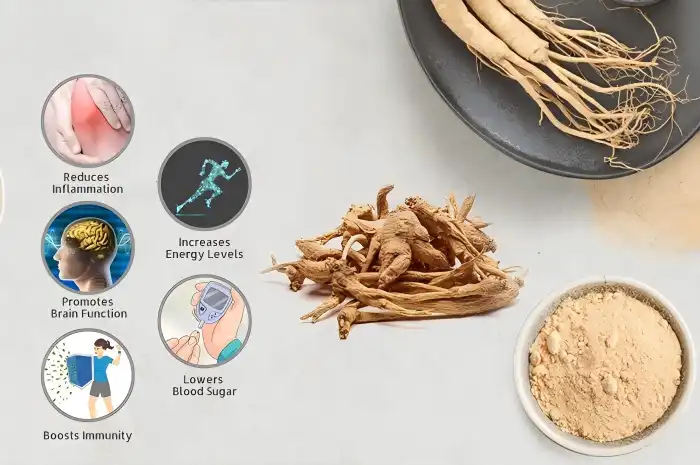
- Cognitive support and fatigue reduction: Multiple randomized trials have demonstrated that standardized ginseng extract improves working memory, reaction time, and self-reported energy levels. A 2020 meta-analysis published in Phytomedicine confirmed statistically significant reductions in mental fatigue with daily ginsenoside supplementation.
- Immune modulation: Ginsenosides Rg1 and Rb1 have been shown to upregulate natural killer cell activity and stimulate cytokine production, making the extract relevant for immune-support product lines targeting seasonal wellness categories.
- Anti-inflammatory activity: Research published in the Journal of Ginseng Research identified ginsenoside Rb1 as an inhibitor of NF-κB signaling, a primary inflammatory pathway. This mechanism supports applications in joint health and recovery supplements.
- Gender-targeted formulations: In male vitality products, ginseng extract supports nitric oxide production and circulatory function. In women's wellness formulations, it has been studied for its role in managing menopausal discomfort and hormonal fluctuation.
The ingredient's clinically proven benefits make it appealing in the nutritional, functional food, and cosmetics categories. This means that your product line can enter more than one market with just one investment in a raw material.
Comparing Ginseng Root Extract Powder with Other Forms
Powder vs. Capsules vs. Tea Formats
Ginseng in all of its business forms is often looked at by procurement teams. Standardized Panax ginseng root extract powder is much more flexible when it comes to preparation. When filling capsules, the adjusted bulk density (0.45–0.65 g/ml) and 80-mesh particle size make it possible to encapsulate things quickly without them sticking together or caking. Lower-assay grades mixed with maltodextrin carriers dissolve moderately to highly in cold water, which is good for liquid forms like energy shots, wellness drinks, and functional waters. While different types of tea are popular in stores, they don't all have the same amount of ginsenoside, so they can't be used for accurate clinical dosing or label claims.
Organic Certified vs. Conventional Extract
Certification has a direct effect on getting into markets and putting a brand in the right place. Organic extract that is approved by the USDA costs more, but it can be sold in natural health stores, by brands with clean labels, and in markets that require an organic statement. Conventional extract that is approved by ISO, HACCP, and FSSC22000 meets the standards for making medicinal and nutraceutical products and is cheaper for large-scale uses. Not just price, but also the medium you want to reach, label standards, and margin structure will help you decide which one to use.
Procurement Considerations for Bulk Buyers and OEMs
When buying large amounts of botanical extracts, there is a real risk that the supplier qualification process will not be done properly. For regulated market entry, the following must be taken into account when evaluating a Panax ginseng extract supplier:
- Certificate portfolio: ISO, USDA Organic, HACCP, FSSC22000, and HALAL certifications confirm that the facility meets international food safety and quality management requirements. Each certification covers a different regulatory dimension, and together they provide comprehensive compliance coverage for North American, European, and Middle Eastern market entry.
- HPLC-verified ginsenoside assay: Supplier CoAs should specify individual ginsenoside monomers (Rb1, Rg1, Re), not just "total saponins by UV," which can overstate potency due to non-specific chromophore absorption.
- Heavy metal and pesticide residue testing: Given ginseng's multi-year soil exposure, third-party testing for lead, cadmium, arsenic, and mercury—as well as organochlorine pesticides—should be standard, not optional.
Traceability from batch to batch, the ability to change the minimum order size, and proven thermal stability (up to 60°C) are some of the other factors that protect the integrity of the formulation further down the line and lower the number of quality deviation events.
Why Ginseng Root Extract Powder Is the Rational Choice for Your Product Line
Specificity is valued in the market for plant supplements. Both consumers and retailers are looking for clean label ingredients that are standardized and backed up by evidence. All three needs are met at the same time by Panax ginseng extract powder. Compared to newly manufactured energizing agents or adaptogens that haven't been studied as much, ginseng has decades of medicinal literature, is known to be safe by major regulatory bodies, and is well-known by consumers, which cuts down on the time needed to educate them.
The ingredient can be used in a wide range of products, from anti-aging serums and softgels to drink powders and private label brands. This makes it easier for OEM makers to find raw materials. Multiple product lines can be based on a single, well-defined extract, which makes purchasing and managing inventory easier.
Conclusion
Ginseng root extract powder is one of the plant ingredients that has been studied the most by scientists and is also one of the most useful active ingredients for products on the market today. It is a safe and sensible addition to nutrition, functional food, and cosmetic product lines because it has a normal ginsenoside profile, is stable during processing, and is certified for a wide range of uses. That potential can be turned into consistent product performance and market credibility if you choose the right supplier—one with verified certifications, HPLC-validated COAs, and clear traceability.
FAQ
1. What is the recommended dosage range for ginsenoside-standardized extract in supplements?
Clinical studies commonly use 200–400 mg per day of a standardized extract containing 4–7% total ginsenosides. For higher-assay extracts (20–80%), formulators adjust inclusion rates accordingly to deliver equivalent active dosage. Always consult regulatory guidance specific to your target market.
2. How do I verify a supplier's ginsenoside assay claims?
Request a Certificate of Analysis specifying individual ginsenoside monomers (Rb1, Rg1, Re) tested by HPLC, not UV alone. Cross-reference the CoA with a third-party lab test on a retained sample before committing to bulk orders.
3. Is Panax ginseng extract compatible with cosmetic formulations?
Yes. The extract demonstrates strong compatibility with common emulsifiers and preservative systems. It stimulates collagen synthesis, provides antioxidant protection, and does not induce oxidation-related color shifts in finished emulsions when handled within recommended temperature parameters.
4. What certifications should I prioritize for US market entry?
For the US market, ISO, USDA Organic (if applicable), HACCP, and FSSC22000 are the most relevant. HALAL certification extends your market reach to Muslim-majority consumer segments domestically and internationally.
Partner with Avans — Your Trusted Ginseng Root Extract Powder Supplier
Pharmaceutical-grade Panax ginseng extract powder is made by Avans NutriHealth Co., Ltd. It has ginsenoside concentrations that are standardized from 10% to 80% by HPLC and is certified by ISO, USDA, HACCP, FSSC22000, and HALAL. Our integrated production plant in Qingdao can make more than 1,000 tons of powder every year and maintains full traceability from the root to the finished ginseng root extract powder. Our technical team is ready to help you whether you need OEM development support or to buy a lot of something. To get samples and prices, email us at Lillian@avansnutri.com.
References
1. Arring, N. M., et al. "Ginseng as a Treatment for Fatigue: A Systematic Review." Journal of Alternative and Complementary Medicine, 2018.
2. Kim, J. H. "Pharmacological and Medical Applications of Panax ginseng and Ginsenosides: A Review for Use in Cardiovascular Diseases." Journal of Ginseng Research, 2018.
3. Ossoukhova, A. et al. "Improved Working Memory Performance Following Administration of a Single Dose of American Ginseng." Human Psychopharmacology: Clinical and Experimental, 2015.
4. Leung, K. W., & Wong, A. S. "Pharmacology of Ginsenosides: A Literature Review." Chinese Medicine, 2010.
5. Reay, J. L., Kennedy, D. O., & Scholey, A. B. "Effects of Panax ginseng, Consumed with and without Glucose, on Blood Glucose Levels and Cognitive Performance." Nutritional Neuroscience, 2006.
6. Grand View Research. "Botanical Extracts Market Size, Share & Trends Analysis Report." Grand View Research Industry Report, 2023.