




What Is Ginseng Root Extract Powder? A Buyer’s Guide
Ginseng root extract powder is a standardized botanical concentration produced from the dried roots of Panax ginseng C.A. Meyer, extracted with water or ethanol and spray-dried to separate the bioactive ginsenosides. This extract is different from the raw ground root since it guarantees a certain assay of active chemicals, often ranging from 5% to 80%. It is a must for nutraceutical, pharmaceutical, and functional food makers. This ingredient is becoming noticed by procurement teams and R&D formulators for its batch-to-batch consistency, high bioavailability, and multi-platform application adaptability as the world seeks evidence-based adaptogens.
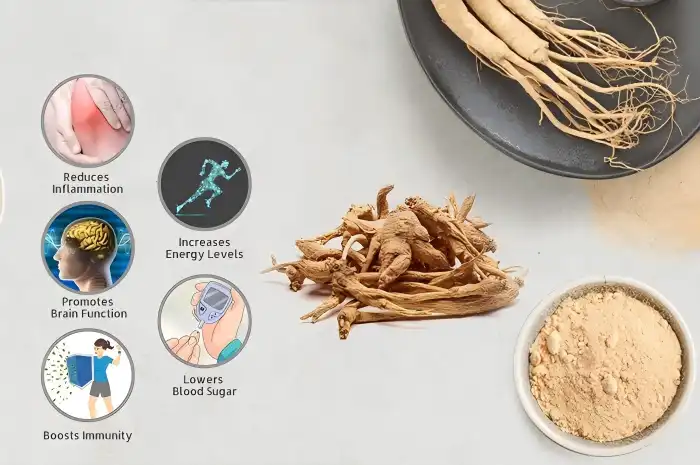
Understanding Ginseng Root Extract Powder
What It Is and How It Is Made
The extraction procedure begins with roots that have been cultivated for at least four to six years, when the concentration of ginsenosides is at its peak. Manufacturers use water-ethanol solvent systems to separate triterpene saponins, especially ginsenoside monomers such as Rb1, Rg1, and Re. Then they spray-dry the concentrated solution into a fine powder. The resulting powder is light yellow to brown yellow in color, with CAS number 72480-62-7. It was designed to be accurate and reliable.
Korean vs. American Ginseng: Key Distinctions
There are two major plant sources in the B2B sector. Asian or Korean Panax ginseng contains higher Rg1-type ginsenosides associated with energizing and cognitive-enhancing properties. American ginseng (Panax quinquefolius) has a greater ratio of Rb1, which is associated with its calming and immune system-modulating properties. The Rg1-to-Rb1 ratio is a key metric for formulators developing adaptogenic blends, since it directly influences the physiological profile of the product. "Clean label" branding is a prized commodity in regulated Western markets, and organic-certified grades are gaining traction there.
Active Composition and Purity Standards
A good Panax ginseng root extract powder has amounts of at least 30 known ginsenosides that can be measured. The main ginsenosides that affect pharmacology are Rb1, Rg1, and Re. HPLC quantification is the standard for assay verification, and it is much more accurate than UV-based methods. Buyers should ask for analysis papers that prove the identity of the ginsenoside monomer, not just the total saponin amount.
Health Benefits and Application Scope
Standardized ginsenoside extracts have been considered as beneficial substances with therapeutic applicability in several peer-reviewed studies. The adaptogenic mechanisms act by modulating the HPA axis and thereby reducing cortisol dysregulation induced by long-term stress. Published research has also demonstrated support for working memory, NK cell function, and glycemic control.
Here are the functional claims assessed and utilized to make judgments regarding formulations in all fields:
- Cognitive and Neuroprotective Support: Ginsenosides Rg1 and Re penetrate the blood-brain barrier, supporting neurotransmitter transmission. In the Journal of Psychopharmacology (2010), clinical evidence from healthy people demonstrated meaningful increases in the quality of working memory and relaxation after standardized ginseng intake.
- Immunological System Activation: Rb1-dominant fractions increase macrophage activity and NK cell proliferation, boosting immunological resilience. This profile is in great demand in immunity-positioned dietary supplements.
- Physical Endurance and Anti-Fatigue: Ginsenoside Rg1 increases mitochondrial ATP synthesis, a process that is well-documented in sports nutrition literature for decreasing perceived effort and speeding recovery.
- Cosmeceutical Bioactivity: The extract induces collagen production by skin fibroblasts and provides antioxidant protection from reactive oxygen species and is a functional active ingredient in anti-aging serums, creams, and tonics.
- These functional characteristics directly influence the market positioning of food supplements, functional beverages and personal care items. Those who deal with powders have more alternatives than do those who work with capsule grains or liquid concentrates. This is particularly relevant for beverage applications where the ginseng root extract powder must be soluble in cold water and stable under acidic conditions.
Finished products normally include between 50 mg and 400 mg of standardized extract per serving, depending on the ginsenoside assay and intended usage. Buyers should check that the quantity plan is consistent with the requirements of the market where they will sell, including FDA standards for food supplements, or EU EFSA botanical restrictions.
How to Choose the Right Panax Ginseng Extract for Your Business
To choose the correct grade, you need to look at more than simply the price per kilogram. Procurement teams should look at standards in five categories before they choose vendors.
The assay concentration, certification stack, evidence of botanical origin, heavy metal compliance, and particle size compatibility with your manufacturing process are the most significant considerations. What the provider is saying is that they have 80% ginsenosides using HPLC, they are not the same as a supplier saying they have the same amount through UV. The technique of analysis is just as crucial as the figure.
You also cannot seek parity of certification with your distribution regions. Retail customers in North America attach increased importance to USDA Organic and HACCP clearance for products. Getting HALAL certification opens up regulated routes for the Middle East and Southeast Asian markets. European distributors are increasingly demanding FSSC22000 alignment as the minimum norm for food safety.
Organic panax ginseng extract costs 20–35% more than standard grades, but it scores on clean labeling and natural marketing, making it a worthwhile investment for health firms looking to woo high-end clientele.
Procurement and Sourcing Guide for Bulk Orders
Evaluating Supplier Credibility
Before choosing a supplier, you should look over the paperwork, not talk about prices. Ask for third-party testing certificates, COAs with HPLC ginsenoside profile, and proof that the heavy metal levels are within the limits set by the USP or EU pharmacopeia. Check to see if the supplier's production site is certified. Any real B2B buyer should have ISO, HACCP, and FSSC22000 certifications.
Pricing, MOQs, and OEM Flexibility
The price of standardized panax ginseng extract in bulk usually goes up or down depending on the amount ordered and the level of analysis. Pharmaceutical-grade 80% HPLC extracts are more expensive because they require more work to make. Entry-level 10% ginsenoside grades are cheaper. Most trustworthy manufacturers have tiered pricing systems that start with trial orders of 25 kg and get a lot cheaper per kilogram when you buy 100 kg or more. Integrated producers with in-house R&D capabilities are more and more likely to offer private label and OEM services, such as custom assay development, mixed matrices, and co-branded packages.
Conclusion
Before you can choose the right botanical ingredient, you need to know what makes a standardized, verified extract different from a generic raw material. Ginseng root extract powder gives procurement teams in the nutraceutical, pharmaceutical, and functional food production industries the measured ginsenoside strength, formulation flexibility, and regulatory-ready paperwork they need. When batch consistency, safety documentation, and technical support are looked at together, not separately, the difference between a reliable supply partner and a transactional vendor becomes clear.
FAQ
1. What ginsenoside concentration should I specify for supplement formulations?
Most dietary supplement formulations use extracts standardized between 10% and 40% ginsenosides via HPLC. Higher assay grades (60–80%) are reserved for pharmaceutical applications or concentrated functional shots where low inclusion volume is critical. Always specify the analytical method—HPLC provides monomer-level identification, while UV total saponins do not.
2. Are there safety or side effect concerns for large-scale use?
At commercially relevant doses, standardized Panax ginseng extract is well-tolerated in healthy adults. However, it may interact with anticoagulant medications and stimulants. Quality auditors should review supplier safety documentation and ensure heavy metal compliance, particularly for lead, arsenic, and cadmium, which concentrate in root crops during extended cultivation cycles.
3. How do I verify authenticity and prevent adulteration in bulk orders?
Request ginsenoside monomer profiling via HPLC rather than UV total assay alone. Authentic Panax ginseng extract carries a characteristic Rg1/Rb1/Re ratio that is difficult to replicate with lower-cost alternatives. Third-party laboratory verification from accredited ISO 17025 labs adds an additional layer of security.
Source Your Ginseng Root Extract Powder Directly from Avans
Avans NutriHealth Co., Ltd. operates as a dedicated ginseng root extract powder manufacturer with standardized ginsenoside concentrations from 10% to 80% HPLC, particle size passing 95% through 80-mesh sieves, and thermal stability up to 60°C. Certifications include ISO, USDA, HACCP, FSSC22000, and HALAL. Our in-stock inventory supports both trial and bulk orders with full OEM capability. Contact our team directly at Lillian@avansnutri.com to request a specification sheet and bulk pricing.
References
1. Kennedy, D.O., & Scholey, A.B. (2003). Ginseng: potential for the enhancement of cognitive performance and mood. Pharmacology, Biochemistry and Behavior.
2. Attele, A.S., Wu, J.A., & Yuan, C.S. (1999). Ginseng pharmacology: multiple constituents and multiple actions. Biochemical Pharmacology.
3. Reay, J.L., Kennedy, D.O., & Scholey, A.B. (2010). Effects of Panax ginseng on quality of memory and secondary memory performance. Journal of Psychopharmacology.
4. Leung, K.W., & Wong, A.S. (2010). Pharmacology of ginsenosides: a literature review. Chinese Medicine.
5. Ernst, E. (2010). Panax ginseng: an overview of the clinical evidence. Journal of Ginseng Research.
6. World Health Organization. (1999). WHO Monographs on Selected Medicinal Plants, Volume 1: Radix Ginseng. WHO Press.