




Lycopene Powder for Antioxidant Supplement Formulation
Lycopene powder is an important ingredient that solves a number of manufacturing problems at once when it comes to making cutting-edge antioxidant products. This very stable carotene extract, which has been standardized to exact strength levels between 5% and 96%, is very good at getting rid of free radicals and fixes the problems that come with raw lycopene oleoresin not being stable. With the help of advanced microencapsulation technology and starch or gelatin matrices, this ingredient changes a sticky, unstable substance into a solid that can flow easily and be used in a wide range of production processes in the pharmaceutical, nutraceutical, and cosmetics industries.
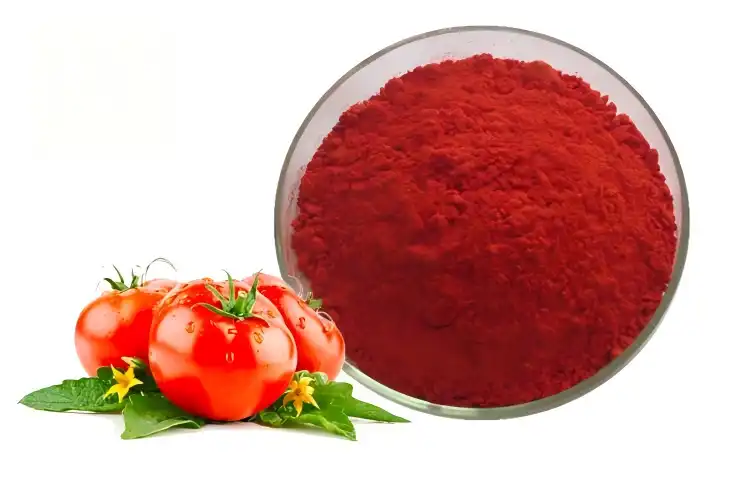
Understanding Lycopene Powder and Its Antioxidant Benefits
The Chemical Nature and Extraction Process
Lycopene is a lipophilic carotene with the formula C40H56. It is mostly found in non-GMO tomatoes (Solanum lycopersicum) or fermented Blakeslea trispora. Supercritical CO2 or liquid extraction is used in the extraction process. This is followed by spray drying or beadlet formation. This method directly fixes the molecule's high sensitivity to light and oxidative degradation, making a stable raw material that can be used on an industrial scale. Studies show that versions that are properly sealed keep more than 90% of their power after 24 months of controlled keeping.
Superior Antioxidant Capacity
According to a study in the American Journal of Clinical Nutrition, this pigment is about twice as good as beta-carotene at stopping singlet oxygen from forming. Its polyunsaturated structure has a conjugated double bond system that effectively neutralizes reactive oxygen species. This keeps cellular parts safe from damage caused by oxidative stress. In studies that looked at cardiovascular health markers, people who took 15 to 30 mg daily had much better results in lipid peroxidation biomarkers than people who were in control groups.
Cardiovascular and Prostate Health Applications
Epidemiological studies regularly show that a higher food intake is linked to a lower chance of heart disease. The chemical stops LDL cholesterol from oxidizing, which is an important step in the formation of arterial plaque. Concerning prostate health, a meta-analysis that looked at more than 26,000 people found that those with higher blood levels had a 19% lower chance of getting prostate cancer. These benefits, backed by evidence, make this ingredient a must-have for making pills for men's health and items that help the heart.
Comparing Lycopene Powder Types and Quality Parameters for B2B Buyers
Organic Versus Synthetic Sources
When choosing between naturally produced and synthetic versions of lycopene powder, procurement managers have to make important choices. Organic choices made from tomatoes usually have a standardization of 5–10% and are approved under USDA and EU organic rules, which makes them appealing to clean label formulations. Chemical synthesis can make synthetic copies that are 96% pure, but they may be closely inspected by regulators in some markets that require natural-source statements. Fermentation-derived options from Blakeslea trispora are a good compromise because they offer 10–20% standardization, a naturally similar molecular structure, and good regulatory positioning across global markets.
Distinguishing from Generic Tomato Powder
A common misunderstanding is that concentrated extract and simple tomato powder are the same thing. Standard tomato powder has fiber, sugars, and other plant parts, as well as about 0.3% to 0.5% active pigment. The quantity of active compounds per gram is 10–200 times higher in purified extract, which allows for exact dosing and formulation freedom. This difference in concentration has a big effect on the stable patterns, bioavailability traits, and cost-effectiveness of making final supplements.
Critical Quality Specifications
Procurement workers should check a number of quality factors when analyzing suppliers. Purity tests using HPLC should match the numbers given within a range of ±5%. Heavy metal testing must show that the product meets USP standards for lead (less than 0.5ppm), arsenic (less than 1.0ppm), cadmium (less than 0.5ppm), and mercury (less than 0.3ppm). Microbiological requirements should be pharmaceutical-grade, with a total plate count of less than 1,000 CFU/g and no bacteria like Salmonella or E. coli present. The range of particle sizes affects how quickly they dissolve and how bioavailable they are. For best results, specs should be between 40 and 80 mesh.
Formulating Antioxidant Supplements with Lycopene Powder: Best Practices
Synergistic Antioxidant Combinations
Leading formulators know that mixing this carotenoid with antioxidants that work well with it produces protective benefits that are stronger than either one alone. Vitamin E, in the form of mixed tocopherols, helps restore oxidized forms, which makes antioxidant action last longer. Selenium helps glutathione peroxidase enzyme systems work better, and vitamin C improves water-phase defense. A well-balanced formula might have 50mcg selenium, 200mg vitamin E, 100mg vitamin C, and 15mg carotenoid in every dose. This would make a full oxidative stress defense system that has been proven to work through in vitro radical scavenging tests.
Excipient Selection for Stability Enhancement
Choosing the right excipients has a huge effect on how long a finished product will last. Because it is lipophilic, it needs carriers that can dissolve in oil in softgel forms. Medium-chain triglycerides work well for this and keep the antioxidants stable when mixed with rosemary extract or mixed tocopherols. Microcrystalline cellulose keeps out moisture, and magnesium stearate keeps things moving smoothly in tablet form. However, stearate levels must be kept below 1% to keep absorption from dropping. Water-dispersible versions can be used in drinks, but they need to be stabilized further with cyclodextrin complexation or emulsification methods.
Quality Control Throughout Manufacturing
Strong quality control methods make sure that products always work the same way. Before production starts, the accuracy of the certificate of analysis is checked by testing the raw materials as soon as they are received. In-process tracking keeps an eye on degradation as it happens during production; long-term contact to temperatures above 80°C can lower potency by 15–30%. The real-life shelf life of a finished product can be predicted by testing its stability under fast conditions (40°C/75% RH for three months). The label claim must still be met at least 90% of the time it expires. Independent labs that do testing for a third party add another layer of proof and boost customer trust.
Procurement Guide: How to Buy Bulk Lycopene Powder for Antioxidant Supplement Production
Identifying Trustworthy Suppliers
When looking at possible providers, you need to do more than just compare prices. Verified producers should have international certifications, such as BRC for managing food safety, HALAL and KOSHER for religious compliance, and Organic certificates if they say their products come from natural sources. Ask for proof that the production site has been inspected, a history of following the rules, and customer references from well-known names. Vertical integration skills are useful for product development partnerships when suppliers offer private-label services and help with custom formulation.
Negotiating Commercial Terms
Knowing how prices work for lycopene powder helps you negotiate more effectively. Prices on the market right now run from $180 to $450 per kilogram, based on the amount of standardization, the way of buying, and the size of the order. For normal grades, the minimum order quantity is usually 25 kg. For custom formulations, however, the minimum order quantity may need to be 100 kg to support production runs. At 100 kg, 500 kg, and 1,000 kg, you can usually get volume prices. At the top levels, you can save 8–15%. There are different ways to pay, ranging from 30% down as a deposit and the rest due when the goods are shipped to LC at sight for foreign deals.
Evaluating Sample Quality Before Commitment
Before committing to bulk sales, a thorough sample review prevents mistakes that cost a lot of money from happening. Ask for examples that come with full analysis reports, such as tests for potency, heavy metals, microbiology, and stability. To confirm what the supplier says, you should do independent verification tests through accredited labs. Check the physical properties, such as color uniformity, particle size consistency, and the ability to move through production equipment. Small-scale testing of compatibility with the ingredients you already have in your recipe helps you find any possible interactions before you start making a lot of them.
Case Studies and Market Trends in Lycopene Supplementation
Successful Product Applications Across Markets
In North America, there is a strong desire for prostate health products that contain this carotenoid along with saw palmetto and zinc, and which usually come in softgel form and provide 15 mg per dose. European drink companies are using more and more water-dispersible forms in functional drinks that protect against UV rays and improve skin health, taking advantage of the fact that people are becoming more aware of "beauty from within" ideas. Asian markets are becoming more interested in heart health pills that contain the substance along with coenzyme Q10 and omega-3 fatty acids to help older people with their heart health.
Emerging Delivery System Innovations
Recent improvements in technology have made it possible to use more forms than before. Liposomal packaging technology makes the drug bioavailable two to three times better than regular powder, so smaller doses are needed to get the same effect. Nanoemulsion devices make it possible to make clear, steady drinks that weren't possible with traditional methods. Chewable gummy forms made with pectin-based matrices are appealing to people who want to use different delivery methods, but staying stable in high-moisture settings needs special manufacturing skills.
Expanding Applications in Cosmetics and Food
The makeup business is becoming more aware of how lycopene powder can be used for photoprotection and anti-aging in skin and food applications. Oral intake lowers UV-induced erythema by about 40% after 12 weeks of taking 16 mg every day, according to clinical research. To meet the demand for clean labels, food companies change artificial colorants like Red 40 with natural ones in bakery items, plant-based meat substitutes, and processed meats. It can be used in a lot of different foods because it is approved as a natural colorant in the EU (E160d) and is GRAS in the US.
Conclusion
When high-quality extract is used as the main ingredient in antioxidant supplements, they meet strict quality standards and provides health benefits that have been proven by science. Procurement teams and R&D departments can make competitive goods if they know the differences between source materials, quality factors, and best practices for formulation. As the market changes, there are more possibilities in the vitamin, cosmetic, and functional food industries. This is because consumers are becoming more aware of the benefits of this carotenoid thanks to ongoing studies.
FAQ
What makes encapsulated forms superior to raw oleoresin?
When exposed to air, light, or heat, raw oleoresin is very unstable and breaks down quickly through oxidation. This makes it very hard to work with in production. Microencapsulated forms keep the active ingredient safe inside protected matrices. This increases the shelf life from weeks to years and allows the powder to flow freely, which is important for industrial manufacturing. Through this process, an unstable liquid is turned into a standard solid that can be used in a wide range of formulations.
How do water-dispersible variants differ from standard forms?
Standard forms are still lipophilic, which means they need oil-based carriers to dissolve in pills or softgels. Water-dispersible options go through extra steps that include emulsifiers or cyclodextrin complexation. This makes particles that float in water without separating. This change makes it possible to use the powder in drinks, syrups, and liquid supplements, which wasn't possible before. However, the cost of production is usually 30–50% higher than with regular powders.
What bioavailability factors affect formulation decisions?
Absorption mostly happens through passive diffusion in the small intestine, and lipids are needed for this to work well. To get the most absorption, formulations should have at least 5 grams of food fat or oil-based carriers. Using micronization or nanoemulsion technology to make particles smaller increases their surface area, which speeds up the rate of breakdown and improves the efficiency of absorption. Studies that compare different ways of delivering drugs show that liposomal forms reach levels in blood plasma that are 2.5–3.2 times higher than regular powder formulations.
Partner with Avans for Premium Lycopene Powder Supply
Avans NutriHealth Co., Ltd. is a licensed producer that sells pharmaceutical-grade products and offers full quality assurance and technical support. Our plant keeps its BRC, HALAL, KOSHER, and organic certifications up to date, which makes sure it follows all global rules and regulations. We can reliably serve producers who need large amounts because we can produce more than 1,000 tons of goods each year and have an R&D team of more than 100 experts.
The usual strength of our goods is between 5% and 20%, and they come from non-GMO tomatoes that have been extracted and microencapsulated using advanced techniques. We provide private label services that are flexible, unique formulation creation, and full analytical data to support regulatory applications. Competitive pricing systems, clear supply chain management, and quick expert support during the growth process are all good for procurement managers.
Email our team at Lillian@avansnutri.com to get full product details, up-to-date prices, and free trial kits. As your reliable lycopene powder provider, we promise to give you top-notch quality, dependable shipping, and support that is focused on building partnerships that help you make new products and succeed in the market.
References
1. Rao AV, Agarwal S. Role of antioxidant lycopene in cancer and heart disease. Journal of the American College of Nutrition, 2000; 19(5): 563-569.
2. Erdman JW, Ford NA, Lindshield BL. Are the health attributes of lycopene related to its antioxidant function? Archives of Biochemistry and Biophysics, 2009; 483(2): 229-235.
3. Giovannucci E, Rimm EB, Liu Y, et al. A prospective study of tomato products, lycopene, and prostate cancer risk. Journal of the National Cancer Institute, 2002; 94(5): 391-398.
4. Petyaev IM, Dovgalevsky PY, Klochkov VA, et al. Lycopene presence in facial skin corneocytes and reduction of UVB-induced skin redness. Nutrition Research, 2016; 36(12): 1389-1395.
5. Stahl W, Sies H. Bioactivity and protective effects of natural carotenoids. Biochimica et Biophysica Acta, 2005; 1740(2): 101-107.
6. Story EN, Kopec RE, Schwartz SJ, Harris GK. An update on the health effects of tomato lycopene. Annual Review of Food Science and Technology, 2010; 1: 189-210.