




How Is Berberine Hydrochloride Powder Used in Supplements?
For capsules, tablets, sachets, and powder blends intended for metabolic and general wellness formulas, berberine hydrochloride powder is used as a standard active ingredient in supplements. The hydrochloride salt is chosen by manufacturers because it has a clear chemical identity, can be measured, and stays stable in solid dosage forms. Before making more of a batch, formulators look at particle size, bulk density, solubility, and taste. Buyers, on the other hand, look at COA data, origin, and packaging. This guide goes over the most important chemistry, formulation steps, quality checks, and sourcing points for US B2B teams.
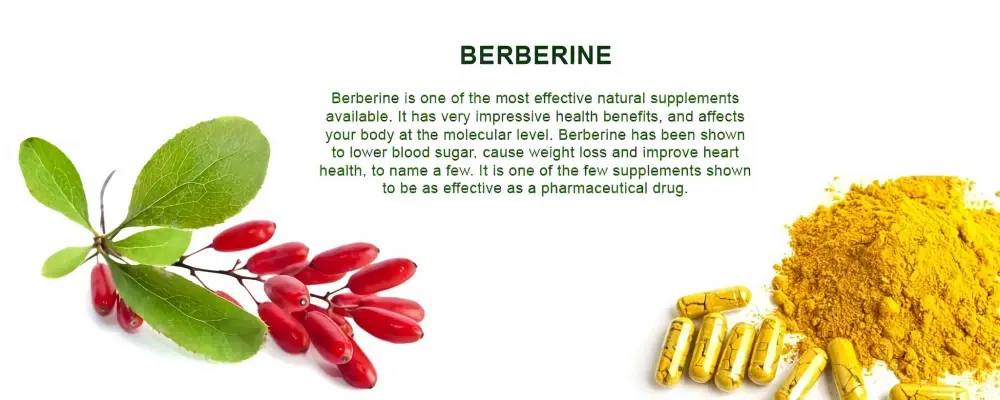
What Is Berberine Hydrochloride Powder?
Chemical Identity and Botanical Sources
Berberine is an isoquinoline alkaloid. Berberine hydrochloride powder is the salt of berberine hydrochloride. CAS 633-65-8. Chemical Formula: C₂₀H₁₈ClNO₄ It is naturally present in plants, including Berberis vulgaris, Berberis aristata, and Coptis chinensis (goldthread). The alkaloid is taken from the roots or bark, then purified and made into a salt. It is then dried and milled into a fine powder. The formulators get a better reading from the purified salt than from the raw herb. "Label-claim math is a lot easier when you don’t have to worry about plant material from harvest to harvest.
Our Product at a Glance
We have a lot of our 97% yellow berberine hydrochloride powder from China in stock. It has CAS number 633-65-8 and can be used for medicine and health care products. The product is certified under many standards like ISO, USDA, HACCP, FSSC22000, and HALAL. The 97% figure is important. It tells us how much powder goes into each capsule or tablet. You can ask our team for the most up-to-date specification sheet and batch COA before you plan a trial. This way, the paperwork will match the lot you receive.
Verifying Natural Origin
Berberine can also be made in a lab, so where it comes from is important. Words like "plant-derived" should be based on proof. We use C14 carbon isotope testing to tell the difference between material that comes from plants and material that comes from petrochemicals. The botanical source is listed in the origin statement. In this step, buyers can add a questionnaire to the supplier and a check by a third-party lab. This protects the language on your labels and stops problems when they are audited. If your brand markets a product as natural, you should ask for the origin documents as soon as possible, before the formulation work starts.
How Berberine Hydrochloride Powder Fits Supplement Formulas
Capsules and Tablets
Most of the time, berberine hydrochloride powder comes in the form of hard capsules. When its bulk density is in a useful range, which for this material is usually between 0.35 and 0.65 g/ml, the yellow powder fills size 0 or 00 capsules well. Tablets also work, but the people who make them need to test how well their fillers, binders, and lubricants work with compression, hardness, and disintegration. It is preferable to mask the alkaloid’s bitter taste and strong color in a coated tablet or capsule shell rather than in an open powder. Pilot batch problems of flow and blend uniformity lead to commercial runs.
Powder Blends, Sachets, and Functional Foods
People who don't like swallowing capsules prefer stick packs, sachets, and drink mixes, but it's harder to make these types of products. Berberine HCl doesn't mix well with cold liquids, so the powder might settle or feel rough. For liquid uses, micronization, surfactants, or solubilizers are helpful. Bitterness can be mellowed with flavor systems and sweeteners, but each one needs to be taste-tested first. Color can also change how a blend looks, so check the finished mix in the containers that your customers will see. Check the stability of the drink at its pH level and temperature.
Private-Label, OEM, and ODM Programs
Most of the time, contract manufacturers and private-label brands start with the market they want to sell to. Supplements in the US are regulated by the Dietary Supplement Health and Education Act of 1994. This law says who is responsible for their safety and how they are sold. First decide on the serving size, label claims, and packaging. Then choose the grade of the ingredients. An OEM partner can use clear specifications to make many of the same formulas. You can get data from our technical team to back up your formulation file, and sample lots let your R&D team try things out before you commit to volume.
Formulation Details That Affect Performance
Particle Size, Flow, and Bulk Density
Assay alone is not indicative of what will happen with a powder on a filling line. The dispersion of emulsions and drink mixes can be improved by fine particles. However, very fine particles may not flow well and may adhere to equipment. The quantity of powder that will fit into a capsule shell will depend upon the bulk density of the powder. This puts a limit on how much dose can be put into each capsule. Not the same as using hot, wet, lit, or humid things. Find out about particle size, try the flow with your own tools, and compare at least two different lots next to each other. These inspections cost very little and prevent having to stop lines in the future.
Solubility and Compatibility
Berberine hydrochloride powder is slightly soluble in cold water. The solubility data is useful due to the temperature of the test conditions, pH, concentration, and mixing time. Things that are different get wet, spread out, and actually dissolve, so a powder that suspends well may not actually dissolve. Test the powder with your formula’s fillers, binders, minerals, botanicals, and other active ingredients. A 2016 review in Fitoterapia said that oral berberine is not very bioavailable. That's why many brands blend it with compounds that help the body absorb it, like piperine, or use delivery systems like liposomes. Any approach like this has to be stable and has to be reviewed by the government.
Dosage Planning and Raw Material Math
Dose levels should be determined by properly qualified people in formulation, regulatory, and medical professions, not by random web tables. Berberine has been tested in clinical studies on people with type 2 diabetes, such as a 2008 study in the journal Metabolism. However, a research dose does not always become a label dose. Use this formula to figure out how much raw material you need: target active quantity times total servings, divided by assay percentage, plus a process allowance. For a 97% test, you’d divide by .97. “Account for safety stock. Quality testing. Sample retention. Review label claims for each market.”
Quality Control and Product Selection
Tests Buyers Should Request
It includes the appearance of the solid, identification, loss on drying, particle size, residual solvents, microbiology, and heavy metals. HPLC shows that the purity is as advertised (97%) and the retention time matches a standard. They also help them work better together with flag alkaloids like palmatine and jatrorrhizine. Buyers often require ICP-MS for mercury, arsenic, cadmium, and lead, and gas chromatography for ethanol and methanol residues as per ICH Q3C. A lot of sales in the US are affected by Prop 65 in CA. Make sure the lot number, method, and test date on the COA match the lot number on the drum. Each batch comes with a COA.
Hydrochloride, Sulfate, and Botanical Extract Compared
The hydrochloride form is more stable and longer-lasting in solid forms than the sulfate form and is preferred by most manufacturers. A standardized botanical extract could still be carrying some of the other parts of the plant, but purified berberine hydrochloride has a more concentrated set of active ingredients. Neither choice is inherently better, because the end result decides. In terms of formulation, bulk powder provides more flexibility for OEM teams, while ready-made capsules could be better for smaller brands looking to get their products to market faster. Also, not all berberine is created equal. A low percentage of berberine extract is not the same as 97% berberine hydrochloride, so read each label carefully.
Storage and Shelf Life
Berberine HCl is light sensitive. Store in a cool, dry place in opaque containers and keep the drum closed when not in use. This is how the powder remains active for 24 to 36 months after opening. Warehouse teams should use first-in, first-out rotation and write down opening dates. Finished goods require their own stability data, as the temperature and humidity when distributing may be different from when the raw materials are stored. Discuss with your supplier when the retests will be performed and ensure that the packaging is appropriate for the conditions of the shipment.
Sourcing Berberine Hydrochloride Powder From a Qualified Manufacturer
Supplier Checks Before You Order
Check first to see if the company you're dealing with is a direct manufacturer, an exporter, or a trading company—this is especially important when working with berberine hydrochloride powder suppliers. Then, ask for records of the quality system, the ability to trace, the lab's capabilities, and the ways to file a complaint. Based on a manufacturing business, Avans NutriHealth is now a sales company. It’s certified ISO, kosher, halal, BRC, and organic. Get samples, a COA that is representative of the whole, and the SDS. Then, test the sample in your own lab. Missing batch numbers, CAS numbers that don't match, claims of unclear origin, and pressure to order a lot before you approve a sample are all red flags.
Pricing, MOQ, and Packaging
It’s not just about the price per kg. “The price depends ultimately on the assay, the origin, the batch size, the extent of testing, the certifications, the packaging, and the shipping terms.” Don't just consider price when you're comparing suppliers; check out their specs and paperwork too. So then you do the document review, the samples, the pilot, the trial order, and the commercial approval. You look at a sequence of sound. Ask the supplier in writing for their MOQ, lead time, Incoterms, and payment terms. Before placing your order, check that the powder is packed in inner bags, drums, or cartons and is labeled correctly.
Production Capacity and Technical Support
Avans NutriHealth carries out its own research and production in China. It has a factory with a production capacity of up to 1000 tons a year and more than 100 workshop technicians. This much space can accommodate medium to large brands and international distributors. Our company’s experts guide our clients to understand every application, whether it is for a capsule, a tablet, or a powder blend. As the item is in stock, we can speak to you directly about when to send the sample and place an order. “We suggest watching batches, looking at complaints, and having a backup plan in place once approval is gained to ensure the safety of your supply chain,” she said.
Conclusion
As a standardized, defined active, berberine hydrochloride powder functions in supplements. It is most often found in capsules, tablets, and powder blends where the taste and solubility are controlled. Its name, CAS number 633-65-8, and 97% assay make it possible to do clear label math and plan doses. How it acts in production is determined by its particle size, bulk density, and ability to dissolve in cold water. Quality depends on an HPLC test, tests for contaminants and solvents, and a batch COA that matches the whole lot. The hydrochloride salt is more stable than the sulfate form, and it can be stored for 24 to 36 months without light damage. The best way for buyers to make sourcing decisions is to check the origin, compare documentation instead of just price, and try out samples before committing to a large order.
FAQ
Q: Is berberine hydrochloride powder soluble in cold beverages?
A: Not really. It doesn't mix well with cold liquids. For liquid uses, micronization, surfactants, or solubilizers are needed, and each mix needs to be tested for stability.
Q: How should I store berberine hydrochloride powder?
A: Store it in a cool, dry place in containers that won't let light in or let air in. When kept this way, it will last 24 to 36 months.
Q: What is the difference between the hydrochloride and sulfate forms?
A: People in business use the hydrochloride form more often because it is more stable and lasts longer in solid form.
Q: How do you verify that the source is plant-derived?
A: We use C14 carbon isotope testing to tell the difference between materials that come from plants and materials that come from petrochemicals.
Q: Does each batch come with a COA?
A: Yes. For each batch, we give you a Certificate of Analysis, which lets you match the data to the batch you get.
Contact Avans NutriHealth for Berberine Hydrochloride Powder Samples and Quotes.
Avans NutriHealth is a Chinese company that sells berberine hydrochloride powder. They have ISO, Kosher, halal, BRC, and organic certifications, and their factory can make up to 1,000 tons of powder every year. They also have a technical team ready to help you with your formulation work. 97% of the items you need are in stock. You can email Lillian@avansnutri.com with your application, annual volume, and target market, or you can go to https://www.avansnutri.com/ and ask for a specification sheet, batch COA, and quote.
References
1. Nature Medicine, 2004. Kong W et al. "Berberine is a novel cholesterol-lowering drug working through a unique mechanism distinct from statins."
2. Metabolism, 2008. Yin J, Xing H, Ye J. "Efficacy of berberine in patients with type 2 diabetes mellitus."
3. Evidence-Based Complementary and Alternative Medicine, 2012. Dong H, et al. "Berberine in the treatment of type 2 diabetes mellitus: a systematic review and meta-analysis."
4. Journal of Ethnopharmacology, 2015. Lan J, et al. "Meta-analysis of the effect and safety of berberine in the treatment of type 2 diabetes mellitus, hyperlipidemia, and hypertension."
5. Fitoterapia, 2016. Liu CS, et al. "Research progress on berberine with a special focus on its oral bioavailability."
6. Phytotherapy Research, 2019. Imenshahidi M, Hosseinzadeh H. "Berberine and barberry (Berberis vulgaris): a clinical review."