




How Is Alpha Lipoic Acid Bulk Powder Used in Supplements?
As an antioxidant raw material, alpha lipoic acid bulk powder is used in supplements. It is mixed, granulated, filled, or compressed to make finished products. It is most often found in capsules and tablets, but it can also be found in powder blends, sachets, stick packs, and softgels. It is mixed with botanical extracts, vitamins, and minerals to make products that are good for your metabolism and immune system. The powder doesn't dissolve well in water and changes color when heated or lit, so getting the right grade, processing carefully, and having clear records are all important. This guide walks your team through each step so they can confidently make plans.
What Is Alpha Lipoic Acid Bulk Powder?
Chemical Identity and Nomenclature
This is an organic sulfur compound also called ALA, lipoic acid, or thioctic acid. It is a chemical, C₈H₁₄O₂S₂, with a CAS number of 1077-28-7. In the supplement world, bulk doesn’t mean the bottles that go to consumers. It means large amounts of material that are sent to be processed further. Here is our alpha lipoic acid. It is a yellow crystalline powder, melting at 60.0-62.0°C. Because the names are different from supplier to supplier, I tell people who want to buy something to make sure that the CAS number, assay, and nomenclature on the technical data sheet match the batch-specific COA before they place their order. We sell stuff from China. We keep it in stock for people who buy supplements and medicines.
Why the Amphiphilic Structure Matters
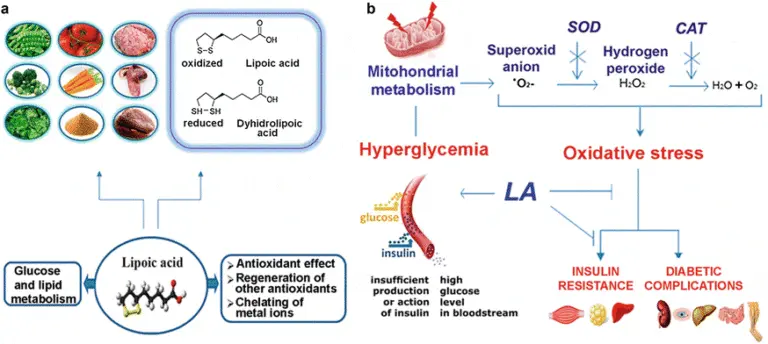
It works with both water- and fat-based environments because ALA is amphiphilic. Scientists say it works with other parts of mitochondrial enzyme complexes that are involved in energy metabolism. In 1995, a paper in Free Radical Biology and Medicine called it a biological antioxidant. In 2011, Pharmacological Reports published a review that talked about its more general biological effects. It can help regenerate antioxidants like vitamin C and vitamin E in their reduced forms, dihydrolipoic acid. The compound can also bind to transition metals like iron and copper. For formulators, these qualities explain why ALA is used in antioxidant blends, but they don't take the place of proof of claims.
Racemic Versus R-ALA
It is a 50/50 mix of R-(+)-lipoic acid and S-(-)-lipoic acid. R-(+)-lipoic acid is the natural form found in the body. R-ALA only has one enantiomer, so it is handled and priced differently. We looked at how the enantiomers work in the body in different dosage forms in a study published in 2014 in Clinical Pharmacology: Advances and Applications. Since the two materials can't be switched out, product teams need to choose early on which one fits their positioning. A racemic powder can be used in a lot of standard antioxidant formulas, and checking the composition on the COA keeps label and specification mistakes from happening.
Main Supplement Formats for Alpha Lipoic Acid Bulk Powder
Capsules and Tablets
The simplest method is to use capsules. Alpha lipoic acid bulk powder can be mixed with fillers and flow agents and then prepared into hard capsules. Tablet makers either use dry granulation, wet granulation, or direct compression. Since our powder is 100% through 40 mesh and 90% through 80 mesh, it can be blended and dosed uniformly. The melting point is close to 60°C. Therefore, heat from milling and high-speed compression should be considered. Often, the teams choose granulation steps or add excipients that keep temperatures low much of the time. Test runs should be performed before scaling up to verify changes in weight, hardness, disintegration, and assay recovery.
Powder Blends, Sachets, and Stick Packs
If capsules aren't your thing, you can get drink mixes and single-serve sachets. The major problem with these formats is that they do not dissolve in water well. It’s important to test the taste, mouthfeel, and settling of ALA, as it doesn’t dissolve well. It is often formulated with sweeteners, flavorings, and dispersing agents. They also check the moisture level, because too much can cause the mixture to clump. ALA smells like sulfur too, so flavor masking is a problem too. If the dosage is low, adding a small amount of ALA to a carrier before adding the main mix helps to distribute it more evenly.
Softgels and Combination Formulas
Some companies put ALA in oil-based fillers for softgels, since it plays well with fats. With this method, you need to check for sedimentation and stability because the powder has to remain evenly spread out during the encapsulation process. There are also many combination products. In keeping with the recycling of antioxidants, ALA is often combined with vitamin C, vitamin E, CoQ10, B vitamins, or plant extracts. When teams are testing the full formula (not just ALA) for compatibility, color, smell, and stability, they should ensure that everything works well together.
Benefits, Claims, and Dosage in the U.S. Market
Where Alpha Lipoic Acid Fits in Product Concepts
ALA is often marketed as an antioxidant that helps with energy metabolism and overall metabolic health. It's also used in ideas about healthy aging, sports nutrition, and beauty from the inside out. A review published in 2009 in Biochimica et Biophysica Acta summed up the molecular processes that make it work as a supplement. People with diabetic neuropathy took between 600 mg and 1,800 mg by mouth every day in the SYDNEY 2 trial, which was published in Diabetes Care in 2006. Since that study was about a medical condition, a supplement brand can't use it to promote a disease treatment. I use these kinds of studies as background for my ideas, not as marketing speak.
Claims and Regulation in the United States
The Dietary Supplement Health and Education Act of 1994 sets the rules for supplements in the US. Structure and function claims are allowed, but the FDA needs to be told within 30 days of marketing, and the statement must include the standard disclaimer that the FDA has not evaluated the statement. It is against the law to say that a product treats or cures a disease. Also, companies that make dietary supplements have to follow the FDA's current rules for making them, which can be found in 21 CFR Part 111. These rules include checking the identities of ingredients that come in. Documents from the supplier help with that step, but they don't take the place of the brand's own regulatory review.
Dosage and Accurate Blending
Not every product works with a single dose. Serving size should be set by qualified formulation and safety professionals because it depends on the format, the type of consumer, and the rules in place. From the point of view of production, I can say that the label amount per serving and the concentration of the raw material are two different numbers that need to be checked—something alpha lipoic acid powder suppliers are particularly attentive to. Controlled weighing, sieving, geometric dilution, and content-uniformity testing make sure that each unit of a low-dose or multi-ingredient formula is the same. Food can also make it harder for the body to absorb ALA, which is something that some brands take into account when they write their serving instructions.
Solubility, Stability, and Formulation Considerations
Understanding Solubility in Water and Fat
ALA is amphiphilic and therefore shows a dual-phase behavior, but it is still not very soluble in water. Teams working with liquids need to differentiate between true dissolution and dispersion or suspension. Emulsifiers, pH adjustment, or solvent systems like ethanol or propylene glycol can be used. Some developers will substitute the yellow powder with salt, but salt is a different ingredient with its own rules and cannot be used in place of this one. Performance is dependent on particle size, mixing time, temperature, and concentration. To get the most accurate answer, it is best to do a test on a bench with the real formula.
Heat, Light, Oxygen, and Moisture
ALA changes when it is hot or bright. According to experts in the field, the powder becomes a rubbery mass that cannot be dissolved in a process known as polymerization. I would suggest storing in a cool, dry place, ideally under 25°C, making sure the packaging is airtight and lightproof. The details of the packaging can be confirmed at the time of quotation. Warehouse workers should make sure to log the temperatures of items being shipped and those held in storage and rotate stock based on the first-in, first-out approach, especially during summer. These simple habits mean assay and appearance don’t get out of production.
Compatibility and Stability Testing
Prior to release, I recommend testing the finished product for assay recovery, blend uniformity, color, smell, disintegration, dissolution, and stability under the planned storage conditions. Some ingredients bind water or change the way ALA functions, so the excipient choice is important. Real-time and accelerated stability studies are conducted to assess whether the label claim remains constant throughout the shelf life. Pilot batches can demonstrate processing behavior, such as sticking, clumping, or odor transfer, that may not be possible to show with small laboratory mixes.
How to Choose Alpha Lipoic Acid Bulk Powder and a Supplier
Reading the Specification Sheet
And the assay percentage is only the beginning. Our bulk powder of alpha lipoic acid has HPLC ≥99.0%, loss on drying ≤0.2%, and residue on ignition ≤0.1%. Buyers are to read these numbers along with the impurity profile, residual solvents, particle size, and HPLC method. Different vendors, including alpha lipoic acid powder suppliers, use terms like “food grade” or “pharmaceutical grade” differently, so be sure you know what the actual limits are and how the product was tested. You need to use the same assay basis and grade definition to compare two quotes on a fair basis. This is particularly the case when we look at offers for wholesale alpha lipoic acid.
Avans NutriHealth Alpha Lipoic Acid at a Glance
These are the most important things that formulators want to know about our product.
- Specification: Yellow crystalline powder, assay ≥99.0% by HPLC, melting point 60.0°C ~ 62.0°C, loss on drying ≤0.2%, residue on ignition ≤0.1%. These limits provide formulators and quality teams a clear baseline for incoming identity testing, batch comparison, and release decisions on each shipment.
- Processing: Particle size passes 100% through 40 mesh and 90% through 80 mesh, which allows smooth mixing and filling. The 50/50 racemic composition provides uniformity of behavior in tablets, capsules, and powder blends. The application trials are still required for each formula, as the excipients and the equipment change the results. If you have any inquiries about processing before ordering, our team is here to talk.
- Documentation and supply: Material in stock. COA, ISO, MSDS, HACCP, and FSSC22000 are available. Avans NutriHealth also has ISO, kosher, halal, BRC, and organic certifications at the company level. Our factory output is 1,000 tons per year for steady supply. Confirm the exact documents needed for your market when sending an inquiry.
These details help the people who buy things quickly check out the product before they ask for samples.
Documents, Certifications, and Supplier Checks
The COA should include the batch number, identity, assay, HPLC method, loss on drying, impurities, microbiological results, and date of production. Look at ISO or HACCP certificates to see who issued them, what they cover, how long they are valid for, and where the food was produced. It is important to check whether the seller is a manufacturer, distributor, or a trading company. It will impact the lead time and the technical support you can receive. Avans NutriHealth is a sales company based on a manufacturing business with over 100 workshop technicians. That means buyers can talk to a team that is connected to production. If the COA is generic or does not match the batch, you can ask the quality department directly about it.
Samples, Pilot Batches, and Total Cost
The lowest unit price may not reflect differences in grade, assay basis, packaging, and freight and delivery terms. A better comparison would be the total landed cost, including the Incoterms, shipping, and duties. Take samples of the whole and test for identity, assay, dispersion, stability, and its behavior during processing. Then you make a small batch of the powder to see how it performs on your equipment. Procurement teams should also inquire about the MOQ, lead time, planning for the future, and how to communicate changes. Distributors shall check the shelf life of the product and check the packaging to make sure it is still good. For OEM projects, serving size, annual volume, and testing duties need to be written down.
Conclusion
When mixed with other ingredients, alpha lipoic acid bulk powder can be used to make capsules, tablets, powder blends, sachets, softgels, and combination formulas. Because it is amphiphilic, it supports antioxidant and metabolic health ideas. However, it is hard to dissolve in water, has a low melting point, and is sensitive to heat and light, which limits the processing options. Since racemic and R-forms are different, the composition should be checked on the COA. In the US, brands must follow FDA rules for dietary supplements and make claims that are true in terms of structure and function. Grade choice is based on the test results, particle size, assay, loss on drying, residue on ignition, and batch documentation. Samples and pilot batches show how the material works in a real formula. It is still up to qualified professionals to decide on dosage and claims.
FAQ
Q: What is alpha lipoic acid bulk powder used for in supplements?
A: It can be used as an antioxidant-rich ingredient in softgels, capsules, tablets, sachets, powder blends, and combination formulas. Brands market it around metabolic and antioxidant health, as long as they don't make any false claims.
Q: Is alpha lipoic acid powder soluble in water?
A: Not all the way, though. Because it tends to suspend or spread out, liquid makers check for taste, settling, and spreading. They may also use emulsifiers, pH adjustment, or solvent systems.
Q: How should I store alpha lipoic acid powder?
A: Keep it in a cool, dry place, preferably below 25°C, in packaging that keeps air and light out. This process can be started by heat and light. It changes the powder into a hard, rubbery mass.
Q: Which documents should I request from a supplier?
A: As well as the MSDS and any relevant certificates like ISO, HACCP, and FSSC22000, you should ask for a batch-specific COA that shows the HPLC test, the amount of loss during drying, any impurities, and batch data. Make sure that the scope, validity, and site are listed in every document.
Request Alpha Lipoic Acid Bulk Powder From Avans NutriHealth.
Looking for a company that makes alpha lipoic acid bulk powder and has materials in stock and technical support? Avans NutriHealth sells ≥99.0% HPLC yellow powder that comes with COA, ISO, MSDS, HACCP, and FSSC22000 paperwork. Our factory makes 1,000 tons of powder every year. To get samples and a formal quote, email Lillian@avansnutri.com with your grade, volume, application, and destination, or go to https://www.avansnutri.com/.
References
1. Free Radical Biology and Medicine, 1995. "Alpha-lipoic acid as a biological antioxidant."
2. Biochimica et Biophysica Acta (General Subjects), 2009. "Alpha-lipoic acid as a dietary supplement: molecular mechanisms and therapeutic potential."
3. Diabetes Care, 2006. "Oral treatment with alpha-lipoic acid improves symptomatic diabetic polyneuropathy: the SYDNEY 2 trial."
4. Clinical Pharmacology: Advances and Applications, 2014. "Enantiomer-selective pharmacokinetics, oral bioavailability, and sex effects of various alpha-lipoic acid dosage forms."
5. Pharmacological Reports, 2011. "Lipoic acid—biological activity and therapeutic potential."
6. Dietary Supplement Health and Education Act, 1994.