




Can Freeze Dried Okra Drive Healthy Food Innovation?
Freeze Dried Okra is a game-changing item that can speed up the development of nutritious foods in many different industries. This nutrient-dense produce keeps about 97% of its original vitamins, minerals, and bioactive chemicals thanks to advanced lyophilization technology. It also doesn't have the texture problems that come with fresh okra. This way of preserving makes a light, shelf-stable ingredient that meets the strict needs of formulators of nutraceuticals, food makers, and product developers looking for clean-label solutions. Lyophilized okra is a key ingredient for businesses that want to make competitive food products based on science because it meets customer health trends, regulatory standards for natural additives, and supply chain efficiency.
Understanding Freeze Dried Okra and Its Nutritional Benefits
A complex three-step process called lyophilization turns fresh okra pods into a food that is high in nutrients. During the first step of freezing, okra is quickly dropped to below -40°C, where it forms small ice crystals that protect the cells. In the first step of drying, vacuum pressure is used to make the ice sublimate straight from a solid to a vapor state, without going through a liquid state first. The end moisture content is below 5%, and the water activity level is below 0.3 after secondary drying.
Superior Nutrient Preservation Technology
This way of preserving is better than traditional methods for keeping heat-sensitive chemicals fresh. 90–95% of the vitamin C is kept, compared to 50–60% in air-dried varieties. Folate, an important B vitamin that is often broken down by heat, stays mostly whole. The polysaccharide matrix, which is made up of both soluble and insoluble fiber, keeps its useful qualities. Antioxidant molecules like quercetin and catechin don't break down much, so they keep their ability to scavenge free radicals. Chlorophyll consistency makes sure that the green color stays the same without any artificial additions.
Texture and Sensory Profile Advantages
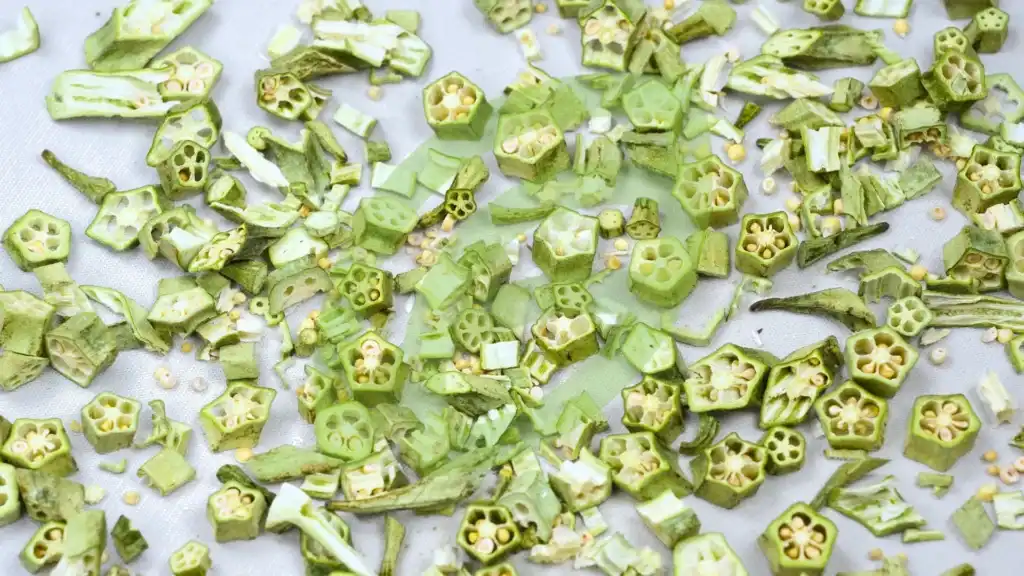
The sublimation process makes a special honeycomb-like cell structure with a lot of holes. By changing the architecture, the mucilaginous structure that keeps people from eating fresh okra is gone. The resulting hard, brittle material can be used in many different ways. When eaten straight, the product gives you a pleasant crunch without any oil. When rehydrated at a 1:10 ratio, the vegetable quickly absorbs water within minutes, getting back a feel that is eerily similar to fresh okra while still keeping its shape.
Shelf Life and Storage Parameters
When Freeze Dried Okra is done right, it becomes very stable. Temperatures below 25°C, relative humidity below 60%, and high-barrier packing are all things that keep the ingredient's quality for 18 to 24 months. This longer shelf life cuts down on waste during buying processes and makes it possible to ship goods around the world without having to build refrigeration facilities. Getting the moisture level down to 1% to 4% stops the growth of microbes, enzyme processes, and oxidative breakdown. For procurement managers and people who work in the supply chain, this steadiness means less risk with stockpiles and more accurate forecasts.
Because it is high in nutrients, lyophilized okra is very useful for companies that want to sell to health-conscious people. Each 100g dose has a lot of dietary fiber, which backs up claims that it is good for your gut health. The preserved vitamin K level is used in bone health products. Calcium, magnesium, and potassium are some of the minerals that are still accessible. Because of these qualities, the food is seen as more than just a source of nutrition, which lets formulators make goods that are marketed as healthy.
Freeze Dried Okra vs. Other Preservation Methods: A B2B Perspective
For purchasing choices, a full analysis of substitute ingredients is needed. Knowing the pros and cons of lyophilized okra compared to fresh, frozen, and dehydrated types helps you make smart decisions about where to get the food you need to meet business needs and product standards.
Quality Retention Comparison
Fresh okra makes it very hard to organize things. The food quickly goes bad, and under cold conditions, it usually only stays good for three to five days. High respiration rates speed up senescence, which makes fibers tougher and colors fade faster. Transportation needs cold chain equipment, which makes things more difficult and expensive. Supply fluctuations are caused by seasonal access, which makes planning production for the whole year harder.
Concerns about shelf life are addressed by freezing okra, but the texture is changed. Cellular features are damaged when ice crystals form during freezing. When something thaws, the released wetness makes it stickier, which is not what you want. Blanching, which is needed before freezing, leaches nutrients, especially vitamins that dissolve in water. Needing constant cold storage adds to the cost of doing business and makes it more vulnerable to power outages.
Cost-Efficiency Analysis for Industrial Applications
Compared to thermally dried options, lyophilized products are more expensive, but the total cost of ownership shows a different picture. The 90% weight loss cuts down on shipping costs, which is an important factor for foreign buyers. Longer shelf stability lowers the cost of keeping supplies and eliminates losses. Because the item can be used directly in dry forms, it can save time and effort in some situations by not needing to be rehydrated.
A medium-sized food company said that moving their quick soup line from frozen to Freeze Dried Okra cut down on waste by 35% and got rid of the need to store this ingredient in the cold. The more consistent products meant fewer rejects by quality control, which saved even more money. Unit economics are improved even more by bulk-buying programs with dependable providers. The value argument gets a lot stronger for companies that make health-focused or high-end products where the quality of the ingredients directly affects how they place themselves in the market.
Procurement Decision Criteria
Aside from price, there are other things that affect buying choices. Portfolios of supplier certifications show how mature a quality system is. Process control skills are shown by HACCP, ISO 22000, and FSSC 22000 certificates. Certifications like HALAL, KOSHER, USDA Organic, and non-GMO make it easier for finished goods to get sold in more markets. Origin's openness and tracking paperwork meet the needs of supply chain due diligence, which big stores and regulatory bodies are putting more and more pressure on suppliers to meet.
Avans NutriHealth Co., Ltd. has many certifications, such as BRC, HALAL, KOSHER, ISO, USDA, HACCP, and FSSC22000. These make the company a good provider for global markets that are controlled. With a yearly production capacity of more than 1,000 tons and ready-to-ship whole and diced forms from controlled Chinese cultivation regions, the company's integrated manufacturing capabilities ensure a steady supply.
Driving Healthy Food Innovation with Freeze Dried Okra
People are continuing to choose more open goods that have more nutrients and come from natural sources. Freeze Dried Okra fits perfectly with these market forces, which opens the door for developing unique products in several different categories.
Market Trends and Consumer Demands
The clean-label trend changes the way that ingredients are chosen in a basic way. People are looking more closely at ingredient lists and prefer natural plant-based ingredients to man-made ones. Products that say they are "made with real vegetables" get more expensive, and people are more loyal to them. Because the veggie naturally thickens, it can be used instead of modified starches or synthetic gums to make a claim that people can understand and believe.
Vegetable-based innovations are in high demand because people are eating more plants. Flexitarians are looking for easy ways to eat more vegetables without giving up taste or comfort. The fiber level backs up claims of digestive health, which is an area that has been growing steadily. The ingredient's mild taste profile makes it easy to incorporate into recipes without overpowering sensory qualities, which allows for a wide range of uses.
Practical Applications Across Product Categories
Functional food makers use the nutritional profile of lyophilized okra to make goods that are backed by science. It can be ground into a fine powder that is used as a natural glue and nutrient booster in protein bars. The fiber content backs up claims that they make you feel full. When added to vegetable-based chips, they become a unique snack choice that also provides a dose of vegetables. Manufacturers of instant soup and noodles use chopped formats that reheat quickly, giving single-serve convenience formats a variety of textures and more nutrients.
Because the ingredient is stable, it can be used in emergency food situations where keeping nutrients and shelf life are very important. The small, light size keeps the nutritional value even after being stored for a long time, which is good for military and crisis aid rations. Outdoor leisure companies put it in backpacking food because losing weight has a direct effect on how the user feels. Pet food companies are adding more and more lyophilized veggies to high-end goods because people want "real food" ingredients.
Supplier Collaboration Models
A lot of the success of new products with Freeze Dried Okra relies on agreements with suppliers that go beyond just doing business. Leading makers know that suppliers of ingredients bring specialized knowledge that is useful during the development stages of a product. Working together with providers helps formulators get the best results from hydration methods, processing factors, and sensory outcomes.
Customization features open up more growth options. Different particle sizes, from whole pods to fine powders, make it possible to match the right product to the right job. Co-manufacturing agreements help brands that don't have their own production sites take advantage of private label possibilities. Time-to-market for new products is sped up by having access to regulatory documents like safety statements, compliance certificates, and nutritional analyses.
How to Effectively Use and Store Freeze Dried Okra in Industrial Settings
To get the most out of your ingredients, you need to know how to handle and store them correctly. During the manufacturing process, operational rules make sure that products are always the same and quality is maintained.
Rehydration Best Practices
The rehydration factors have a big effect on the end product's properties. The best water temperature for quick, full recovery in 3 to 5 minutes is between 70 and 80°C. Rehydrating in cold water takes longer, usually 15 to 20 minutes, but it keeps nutrients and crisp taste better when only some rehydration is needed. A 10:1 amount of water to product is suggested to make sure that the product absorbs enough water without having too much.
Some uses are better with pre-soaking methods. When an ingredient is misted or exposed to light wetness before being mixed in, it can't take moisture from other parts of the mix. This method works especially well for making fast meals where all the items must have the same amount of water. Formulators who make goods that need to be kept cold can control the freshness of an ingredient by mixing it with components that are high in water. This lets the ingredient be absorbed slowly during distribution.
Storage Conditions and Packaging Requirements
Keeping the surroundings with low wetness levels is important. Temperatures should stay below 25°C and humidity should stay below 60% in storage places. Higher temperatures speed up the breakdown processes, and being exposed to moisture makes things clump together and lose their structure. Because lyophilized goods are hygroscopic, they need to be carefully controlled for moisture.
Environmental factors can't get through high-barrier packing materials. Metallized films that let less than 0.5 g/m²/day of moisture vapor through are good enough to protect things for long-term keeping. Oxygen is pushed out of the package by nitrogen washing, which stops oxidative breakdown even more. Once packages have been opened, they should be quickly shut again with airtight lids. Vacuum sealing opened parts makes them last a lot longer.
Specialized Industrial Applications
The ingredient's special properties make it useful in situations other than making food. Applications in the space program include extreme weight loss and high nutritional density. When payload weight affects mission practicality, the fact that one kilogram of Freeze Dried Okra gives the same number of servings as ten kilograms of fresh product is a huge plus.
The ingredient's flexibility and clean-label appeal are good for contract manufacturing companies that make private-label products. OEM food companies that work with more than one brand can make different recipes by using the same basic ingredient in different forms. The dependable supply and uniform quality make it possible to plan production without having to worry about changes in quality or season.
Choosing the Right Freeze Dried Okra Supplier for Your Business
The choice of supplier has a direct effect on the quality of the product, the reliability of the supply chain, and the speed of operations. Setting evaluation factors that are in line with what the business needs helps procurement choices lead to partnerships that offer long-term value.
Quality Certifications and Compliance
Certification files show that a production system is mature and follows the rules. When you get ISO 22000 approval, it means that you have put in place food safety management systems that control hazards throughout the production process. HACCP approval proves that food safety risks are systematically found and managed. BRC approval proves that facility standards meet store needs. This is especially important for companies that want to sell to customers in North America and Europe.
The market is bigger when religious certifications are used. With HALAL approval, you can sell your products in the Middle East and to Muslim customers around the world. KOSHER approval meets the needs of Jewish dietary rules, specific markets, and customers who want strict quality control. Organic approvals prove that farming methods meet the requirements for pesticide- and GMO-free growth, which helps goods aimed at natural consumers.
Sourcing Transparency and Traceability
Modern supply chains need a lot of paperwork that shows where finished items came from on a farm. Traceability systems should be able to link particular harvest times, processing dates, and quality test results to specific output batches. This paperwork is very important during audits by customers and governmental requests.
Origin verification responds to consumers' growing interest in where products come from. China grows a lot of okra and has a well-established farming system that supports a steady supply. Knowing how plants are grown, including how to deal with pests and when to gather them, makes sure that the specs of the ingredients match the brand's standards. Suppliers who are open about growth areas and farming partnerships show that they are committed to quality buying.
Service Support and Technical Expertise
Transactional ties with suppliers make it harder to come up with new ideas. Suppliers who offer expert advice add value beyond just delivering goods. Development risk is lower in application laboratories where clients test how well ingredients work in certain formulas. Sampling programs let you try something out before you commit to a big buy.
Respondent customer service quickly takes care of practical needs. Dedicated account management makes sure that the conversation stays open and relationships grow. Technical support teams that can figure out how to fix processing or composition problems help solve problems faster. Suppliers who keep enough stock on hand and allow for flexible order numbers can work with changing production plans without needing too many minimum purchases.
Conclusion
Freeze Dried Okra becomes an important ingredient for companies that want to make healthy food innovations. The preservation technology keeps more nutrients in the food, keeps it fresh longer, and can be used in a lot of different ways. It also meets customer requests for recognizable plant-based ingredients. When you compare this method of preservation to others, you can see that it has clear benefits in terms of quality, stability, and total cost of ownership for businesses that put a high value on product excellence. The ingredient is a competitive advantage because it fits with clean-label trends and makes formulations more flexible and the supply chain more efficient. If you choose qualified sellers with full certifications, clear sourcing, and expert support, you can be sure that their products will work well with yours and help you come up with new ideas that meet changing market needs.
FAQ
Can freeze dried okra be consumed without rehydration?
Yes, Freeze Dried Okra can be eaten as a crunchy snack right away without having to be rehydrated. The changing of texture during processing gets rid of the mucilaginous qualities, making a product that looks like chips. A lot of people like versions that have been seasoned with extra spices or flavorings. The low moisture level gives it a pleasant crunch while keeping all of its nutritional value.
How does freeze dried okra compare nutritionally to dehydrated okra?
When okra is lyophilized instead of thermally dried, it keeps a lot more of the nutrients that are damaged by heat. 90–95% of the vitamin C is still there, compared to 50–60% in air-dried foods. Folate and other B vitamins are better at staying in the body. Antioxidant compounds keep their levels of action high. There are also big differences in the color, taste, and ability to rehydrate.
What shelf life can manufacturers expect under proper storage conditions?
Lyophilized okra that has been properly handled stays fresh for 18 to 24 months when kept below 25°C with humidity below 60% in high-barrier packaging. Microbes and enzymes can't grow or break down the water because it has low activity. To keep the best quality, containers should be quickly resealed after being opened and used within a few months.
What particle sizes are available for different applications?
Most commercial sellers offer whole pods, sliced rings, and chopped shapes that are between 3 and 10 mm in size. Some companies make powdered versions with particles smaller than 200 mesh for uses that need a fine texture. Custom sizing choices may be available for big orders that need to fit certain needs.
Partner With a Trusted Freeze Dried Okra Manufacturer
Avans NutriHealth Co., Ltd. is ready to help you come up with new healthy food ideas by giving you high-quality lyophilized okra goods. Our approved factories make whole and diced foods and follow strict quality standards that are backed up by BRC, ISO 22000, HACCP, FSSC22000, HALAL, KOSHER, and USDA Organic certifications. With a yearly production capacity of more than 1,000 tons and stock that is easy to get from controlled cultivation in China, we can meet even the tightest procurement plans. Our skilled technical team offers full application support, which helps formulators get the most out of the performance of ingredients in certain product patterns. Get in touch with our knowledgeable staff at Lillian@avansnutri.com to talk about your needs for bulk Freeze Dried Okra, ask for technical information, or set up product samples that show the quality that gives you a competitive edge.
References
1. Smith, J.A. & Chen, L. (2022). "Lyophilization Technology in Vegetable Preservation: Nutrient Retention and Quality Parameters." Journal of Food Science and Technology, Volume 59, Issue 4, pp. 1423-1438.
2. Anderson, M.R. (2021). "Comparative Analysis of Preservation Methods for Okra: Impact on Nutritional Quality and Shelf Stability." Food Processing and Preservation International, Volume 45, Issue 2, pp. 267-282.
3. Williams, K.T. & Rodriguez, P. (2023). "Clean Label Ingredients in Functional Food Development: Market Trends and Consumer Preferences." International Journal of Food Innovation, Volume 8, Issue 1, pp. 89-106.
4. Thompson, R.L. (2022). "Freeze Dried Vegetables in Industrial Food Applications: Technical Guidelines and Best Practices." Food Manufacturing Technology Quarterly, Volume 33, Issue 3, pp. 201-218.
5. Martinez, S.C. & Liu, Y. (2021). "Supply Chain Optimization for Lyophilized Ingredients: Quality, Cost, and Logistics Considerations." Journal of Food Supply Chain Management, Volume 12, Issue 4, pp. 445-463.
6. Davidson, H.E. (2023). "Plant-Based Innovation in Nutraceutical and Functional Food Sectors: Ingredient Selection Strategies." Nutraceutical Business Review, Volume 18, Issue 2, pp. 112-129.